
Choosing the right scope ring significantly impacts a shooter’s performance. A 0 MOA mount suits short to medium distances. It keeps the rifle’s scope aligned without any tilt, ensuring a straightforward zeroing process. On the other hand, a 20 MOA rail introduces a downward tilt of 20 minutes of angle. This design saves elevation adjustment for long-range targets, especially beyond 600 yards, making it ideal for precision shooting. Accessories like these help tailor a rifle to specific shooting styles and distances.
Key Takeaways
- 0 MOA scope rings work well for short to mid-range shots. They stay flat, making aiming easier and lowering mistakes.
- 20 MOA scope rings are made for long-distance accuracy. They help adjust for height, great for targets over 600 yards.
- Think about how far you shoot and your rifle setup. Pick the right ring type to match your shooting needs for best results.
What is MOA and Its Importance in Scope Rings
Understanding Minute of Angle (MOA)
Minute of Angle (MOA) is a critical concept for shooters aiming to improve accuracy. It represents an angular measurement, translating to approximately 1 inch at 100 yards. While the precise value is 1.047 inches, most shooters simplify it to 1 inch for quick calculations. This simplification allows for faster adjustments during shooting sessions.
To calculate MOA at any distance, multiply 1.047 by the distance in yards and divide by 100. For example, at 500 yards, 1 MOA equals approximately 5.235 inches. This proportional relationship helps shooters predict bullet impact points at various ranges.
| Distance (yards) | Inches in True MOA | Inches in Approx. MOA |
|---|---|---|
| 100 | 1.047 | 1 |
| 200 | 2.094 | 2 |
| 300 | 3.141 | 3 |
| 400 | 4.188 | 4 |
| 500 | 5.235 | 5 |
| 600 | 6.282 | 6 |
| 700 | 7.329 | 7 |
| 800 | 8.376 | 8 |
| 900 | 9.423 | 9 |
| 1000 | 10.470 | 10 |
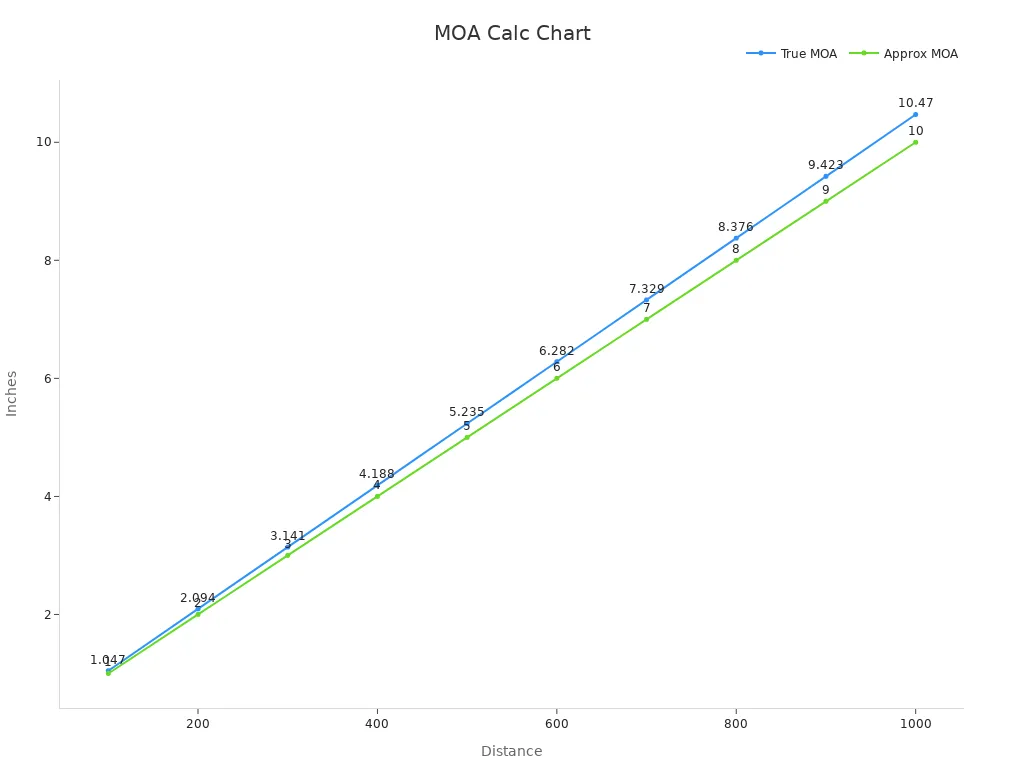
Understanding MOA empowers shooters to make precise adjustments, especially when using a scope ring tailored to their shooting style.
MOA’s Role in Elevation Adjustments
MOA plays a pivotal role in elevation adjustments, especially for long-range shooting. As bullets travel farther, external factors like gravity, wind, and the Earth’s rotation affect their trajectory. Shooters rely on MOA to compensate for these variables and maintain accuracy.
For instance:
- At 1000 yards, spin drift can cause a bullet to shift approximately 1 MOA to the right.
- A 10 MPH crosswind may push the bullet up or down by ½ MOA.
- The Coriolis Effect, caused by Earth’s rotation, can deflect the bullet slightly, requiring an adjustment of about one click per 1000 yards.
Long-range shooters often use tools like ballistic calculators and weather meters to refine their MOA adjustments. These tools, combined with the right scope ring, ensure that shooters can hit their targets with precision, even under challenging conditions.
0 MOA Scope Rings Explained
Features of 0 MOA Scope Rings
0 MOA scope rings are designed for precision and simplicity. They maintain a flat alignment between the rifle and the scope, making them ideal for short to medium-range shooting. These rings are crafted with high-quality materials to ensure durability and performance.
| Feature | Specification |
|---|---|
| Rings | 34 mm |
| Tilt | 0 MIL/MOA |
| Height | 38 mm/1.5" |
| Mount Body Length | 151 mm/5.94" |
| Weight | 270 g/9.5 oz |
Manufacturers often use 7075 T-6 aluminum for these rings, a material known for its strength and lightweight properties. The surface hardness of 60 Rockwell ensures resistance to wear and tear. With a diameter tolerance of ±0.001", these rings provide a secure and precise fit for the scope.
| Feature | Specification |
|---|---|
| Material | 7075 T-6 aluminum |
| Width | 1.2 inches |
| Diameter Tolerance | ±0.001" |
| Surface Hardness | 60 Rockwell |
Benefits for Short to Medium-Range Shooting
For short to medium-range shooting, 0 MOA scope rings offer unmatched reliability. They allow shooters to zero their rifles without additional adjustments, making the process straightforward. This simplicity reduces the chances of errors, especially for beginners or those focusing on targets within 300 yards.
Hunters and recreational shooters benefit greatly from these rings. They provide a stable platform for scopes, ensuring consistent accuracy. The lack of tilt means shooters can focus on their technique rather than compensating for elevation adjustments. This feature makes 0 MOA rings a popular choice for those who prioritize ease of use and dependability.
Ideal Scenarios for Using 0 MOA Scope Rings
0 MOA scope rings shine in scenarios where precision at shorter distances is key. They are perfect for hunting in wooded areas, where targets are often within 100-200 yards. Competitive shooters in disciplines like 3-gun matches also favor these rings for their quick target acquisition and minimal adjustment requirements.
These rings are also ideal for rifles with limited elevation adjustment in their scopes. By maintaining a flat alignment, they maximize the scope’s existing capabilities. Shooters who primarily engage in recreational shooting or practice at local ranges will find 0 MOA rings to be a practical and effective choice.
20 MOA Scope Rings Explained
Features of 20 MOA Scope Rings
20 MOA scope rings are precision-engineered for long-range shooting. Their design incorporates a 20-minute angle incline, which tilts the scope downward relative to the rifle barrel. This feature allows shooters to maximize their scope’s elevation adjustment, making it easier to hit distant targets.
| Feature | Specification |
|---|---|
| Material | 7075-T6 aluminum |
| Finish | Type III hardcoat anodized |
| Ring diameter | 30mm |
| Mount type | Quick-Detach (QD) |
| Rail interface | MIL-STD-1913 Picatinny |
| Height | 1.5" from top of rail to center |
| Weight | Approximately 7.9 oz (224 g) |
| Length | 5.0" (127 mm) |
| Torque specs | Ring screws: 25-30 in-lbs; Rail clamp screws: 65 in-lbs |
These rings are built with durability in mind. The 7075-T6 aluminum construction ensures strength without adding unnecessary weight. The quick-detach system allows for easy mounting and removal while maintaining zero. Their compatibility with Picatinny rails makes them versatile for various rifle setups.
Advantages for Long-Range Precision Shooting
A 20 MOA scope ring provides a significant advantage for long-range precision shooting. By introducing a downward tilt, it enables the scope to zero closer to the bottom of its elevation range. This adjustment frees up more elevation for distant shots, which is essential when engaging targets beyond 500 yards.
- A tapered scope rail elevates the muzzle in relation to the line of sight.
- Shooters can utilize more of their scope’s adjustment range, enhancing accuracy.
- The inclined design allows for an additional 20 inches of elevation at 100 yards, making it easier to compensate for bullet drop at extended distances.
For example, in Precision Rifle Series (PRS) matches, shooters often face targets at distances ranging from 300 to 1200 yards. The elevation travel provided by a 20 MOA scope ring ensures they can maintain image clarity and minimize distortion, even at the edges of the scope’s adjustment range.
When to Use 20 MOA Scope Rings
20 MOA scope rings excel in scenarios where long-range accuracy is critical. They are ideal for competitive shooting events, such as PRS matches, where targets are placed at varying distances. Hunters pursuing game in open terrains, like plains or mountains, also benefit from the extended range these rings provide.
These rings are particularly useful for rifles with scopes that have limited elevation adjustment. By tilting the scope downward, they unlock additional adjustment capacity, ensuring the shooter can compensate for bullet drop over long distances. Whether engaging steel targets at 1000 yards or hunting elk across a canyon, 20 MOA scope rings offer the precision and reliability needed for success.
Comparing 0 MOA and 20 MOA Scope Rings
Elevation Adjustment Differences
The primary distinction between 0 MOA and 20 MOA scope rings lies in their elevation adjustment capabilities. A 0 MOA scope ring keeps the scope and rifle barrel perfectly aligned, offering a neutral setup. This configuration works well for short to medium distances, where minimal elevation adjustment is required. In contrast, a 20 MOA scope ring introduces a downward tilt, effectively shifting the scope’s zero point closer to the bottom of its elevation range. This design unlocks additional elevation travel, which is crucial for long-range shooting.
To illustrate this difference, consider the following comparison:
| Scope Type | Total Elevation Travel | Maximum Range | Available Adjustment Travel |
|---|---|---|---|
| 0 MOA Rail | 60 MOA | 875 yards | 30 MOA |
| 20 MOA Rail | 60 MOA | 1150 yards | 50 MOA |
The table highlights how a 20 MOA scope ring extends the effective range of a rifle by providing more adjustment travel. Shooters aiming at targets beyond 875 yards benefit significantly from this additional elevation capacity. For instance, in competitive shooting scenarios, this extra adjustment can mean the difference between hitting or missing a distant target.
Tip: If your scope has limited elevation adjustment, pairing it with a 20 MOA scope ring can help you maximize its potential for long-range accuracy.
Range Capabilities
The range capabilities of 0 MOA and 20 MOA scope rings cater to different shooting needs. A 0 MOA scope ring is ideal for engagements within 300 to 600 yards. It provides a straightforward setup, allowing shooters to focus on precision without worrying about complex adjustments. This makes it a popular choice for hunters in wooded areas or recreational shooters practicing at local ranges.
On the other hand, a 20 MOA scope ring excels at extending a rifle’s effective range. By tilting the scope downward, it compensates for bullet drop over long distances. This feature is particularly valuable for precision shooters targeting objects beyond 600 yards. For example, a shooter participating in a Precision Rifle Series (PRS) match may need to engage targets at 1000 yards or more. The 20 MOA scope ring ensures they have enough elevation adjustment to maintain accuracy at such distances.
Note: While a 20 MOA scope ring enhances long-range performance, it may not be necessary for short-range shooting. Always consider your typical shooting distances before making a choice.
Practical Applications for Each Type
The practical applications of 0 MOA and 20 MOA scope rings depend on the shooter’s goals and environment. A 0 MOA scope ring is perfect for hunters pursuing game in dense forests, where targets are often within 200 yards. It also suits competitive shooters in disciplines like 3-gun matches, where quick target acquisition and minimal adjustments are key. Recreational shooters who frequent ranges with limited distances will find this setup both practical and reliable.
In contrast, a 20 MOA scope ring is the go-to choice for long-range enthusiasts. Competitive marksmen, such as those in PRS matches, rely on its extended elevation capabilities to hit steel targets at extreme distances. Hunters in open terrains, like plains or mountains, also benefit from the added range. For example, a hunter targeting elk across a canyon may need to account for significant bullet drop. The 20 MOA scope ring provides the necessary adjustment to ensure a clean and ethical shot.
Inspiration: Whether you’re a hunter, a competitor, or a recreational shooter, the right scope ring can elevate your performance. Choose the one that aligns with your shooting style and unlock your full potential.
Choosing the Right Scope Ring for Your Shooting Style
Factors to Consider: Distance and Rifle Setup
Selecting the right scope ring begins with understanding your shooting distance and rifle setup. These two factors play a crucial role in determining the type of scope ring that will best suit your needs. For short to medium-range shooting, a 0 MOA scope ring offers simplicity and precision. It works well for hunters in wooded areas or recreational shooters at local ranges. Conversely, long-range enthusiasts often benefit from a 20 MOA scope ring, which provides the additional elevation adjustment needed for distant targets.
The rifle setup also influences the choice. Rifles with scopes that have limited elevation adjustment may require a 20 MOA scope ring to unlock their full potential. Additionally, the type of rail system on your rifle—Picatinny or Weaver—affects compatibility. Ensuring the scope ring matches your rifle’s rail system is essential for a secure and stable fit. Shooters should also consider the height of the scope ring. Medium-height rings generally work well for most setups, but it’s important to ensure enough clearance for the scope’s objective bell and bolt operation.
Tip: Always check the manufacturer’s specifications for your rifle and scope to ensure compatibility with the scope ring.
Aligning Scope Rings with Shooting Goals
Your shooting goals should guide your choice of scope ring. Hunters, competitive shooters, and recreational marksmen all have different needs. For hunters pursuing game in dense forests, a 0 MOA scope ring provides a straightforward setup that prioritizes quick target acquisition. Competitive shooters in disciplines like 3-gun matches also benefit from the simplicity of 0 MOA rings, as they allow for rapid adjustments without overcomplicating the process.
On the other hand, long-range precision shooters often require the extended elevation adjustment offered by a 20 MOA scope ring. This type of ring is ideal for hitting targets at distances beyond 600 yards, where bullet drop becomes a significant factor. For example, a shooter participating in a Precision Rifle Series (PRS) match may need to engage targets at varying distances, often exceeding 1000 yards. The 20 MOA scope ring ensures they have the necessary adjustment range to maintain accuracy.
Inspiration: Define your shooting goals clearly. Whether you aim to master long-range precision or excel in close-range hunting, the right scope ring can help you achieve your objectives.
Tips for Making the Best Choice
Making the best choice for a scope ring involves careful consideration of several practical factors. Follow these expert recommendations to ensure you select the right one for your needs:
- Identify the appropriate ring diameter for your scope. Most scopes specify their tube diameter, such as 30mm or 34mm.
- Decide on the ring height. Medium-height rings are effective for most setups, but ensure there’s enough clearance for the scope’s objective bell and bolt operation.
- Understand how different manufacturers measure height to avoid compatibility issues.
- Determine how the rings will attach to your firearm. Check for compatibility with the screw patterns of your specific model.
- Choose between Picatinny and Weaver rails, noting their differences. Picatinny rails offer more versatility, while Weaver rails are often lighter.
- Opt for two independent scope rings for flexibility in mounting. Position them as far apart as possible to enhance stability.
- Use a torque wrench to tighten screws to the manufacturer’s recommended levels. This prevents damage to the scope and ensures a secure fit.
Note: Avoid excessively low mounts that can hinder visibility and comfort. A proper fit enhances both accuracy and shooting experience.
By following these tips, shooters can confidently select a scope ring that aligns with their rifle setup and shooting goals. The right choice not only improves performance but also enhances the overall shooting experience.
Choosing between 0 MOA and 20 MOA scope rings depends on shooting distance, style, and precision needs. A 0 MOA ring suits short to medium ranges, while a 20 MOA ring excels at long-range precision. The table below highlights practical recommendations for different setups:
| Rifle Model | Caliber | Shooting Distance (Primary) | Scope Selection (Example) | Recommended MOA Base |
|---|---|---|---|---|
| Remington 700 Long Range | .300 Win Mag | 800+ Yards | Vortex Viper PST Gen II 5-25×50 | 20 MOA |
| AR-15 | 5.56 NATO | Up to 600 Yards | Primary Arms SLx 1-6x ACSS | 0 MOA |
| Tikka T3 Lite | 6.5 Creedmoor | 300-800 Yards | Leupold VX-Freedom 3-9×40 | 0 MOA or 20 MOA |
| Ruger American Ranch | .223 Rem | Up to 300 Yards | Bushnell Engage 4-16×44 | 0 MOA |
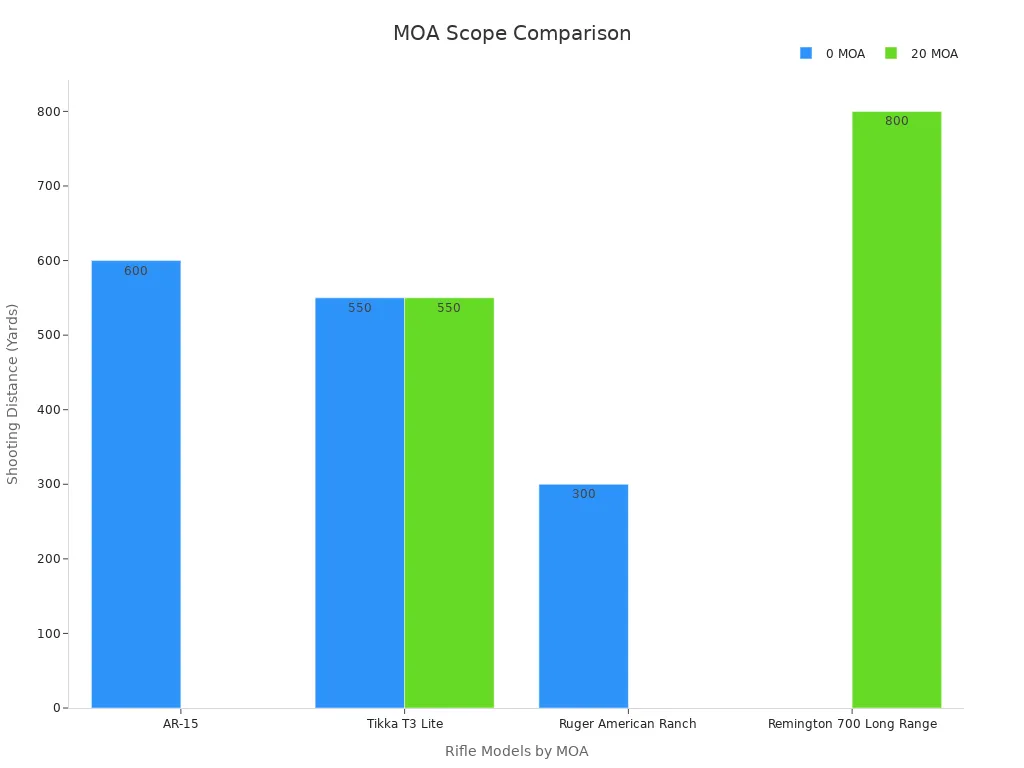
Shooters should evaluate their goals and equipment carefully. Whether mastering long-range precision or excelling in close-range hunting, the right scope ring can unlock potential and elevate performance.
FAQ
What does "MOA" mean in scope rings?
MOA, or Minute of Angle, measures angular adjustments. It helps shooters compensate for bullet drop and wind drift, ensuring accuracy at various distances.
Tip: Think of MOA as a tool to fine-tune your aim for precision shooting.
Can I use a 20 MOA scope ring for short-range shooting?
Yes, but it’s unnecessary. A 20 MOA ring tilts the scope for long-range adjustments. For short distances, a 0 MOA ring offers simplicity and better alignment.
How do I know if my scope needs a 20 MOA ring?
Check your scope’s elevation adjustment range. If it struggles to zero at long distances, a 20 MOA ring can provide the extra adjustment needed.
Note: Always match your scope ring to your shooting goals and typical distances.
Post time: May-09-2025