
Precision in hunting and shooting relies heavily on mastering rifle scope techniques. Proper scope use enhances accuracy, even at challenging distances. Hunters who practice less frequently benefit significantly from scopes, achieving tighter groups compared to open sights.
- Scoped rifles allow hunters to achieve 1-inch groups at 100 yards, showcasing their precision potential.
- For effective shots beyond 300 yards, rifles must consistently group within 1 inch at 100 yards, emphasizing the need for scope proficiency.
A well-utilized rifle scope boosts confidence and ensures success in the field.
Key Takeaways
- Attach your rifle scope correctly to shoot accurately. Keep it level and tighten screws carefully to prevent harm.
- Set eye relief for ease. Place the scope where you can see clearly without discomfort, making shooting easier.
- Pick a reticle that fits your purpose. Basic ones are good for hunting, while special reticles help with far-away shots.
Setting Up Your Rifle Scope
Mounting the Rifle Scope Securely
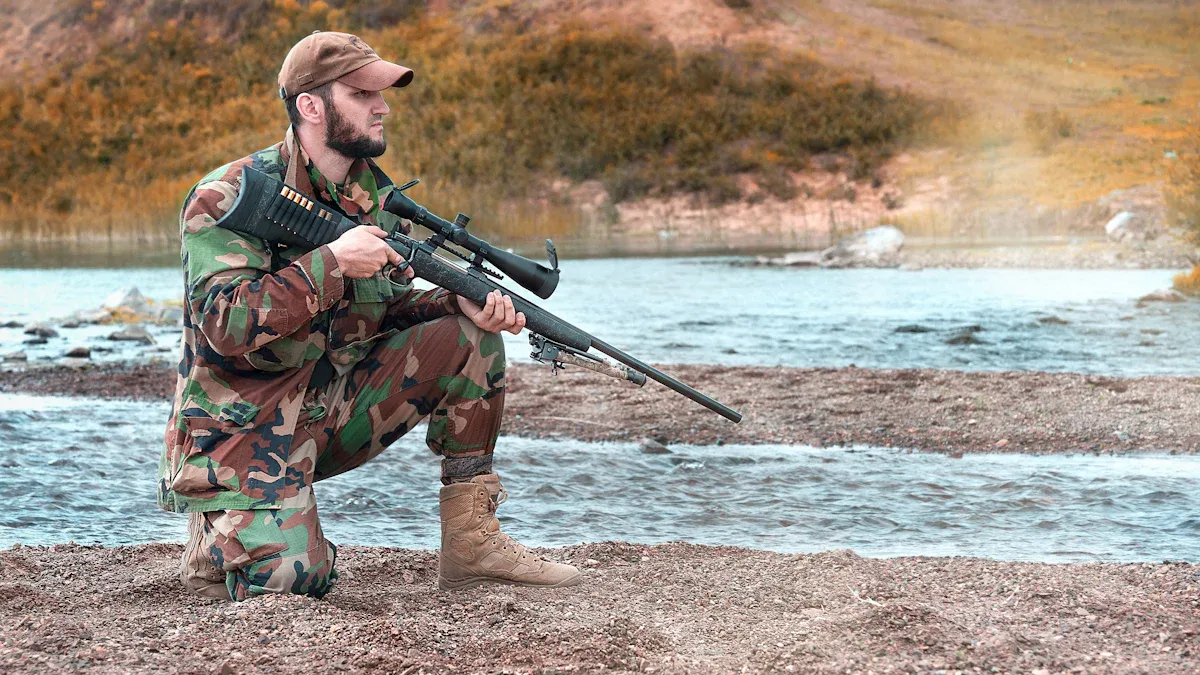
Properly mounting a rifle scope is essential for maintaining accuracy and consistency. A secure and level installation ensures that the scope aligns perfectly with the rifle’s action. To achieve this:
- Level the scope to align it with the rifle’s horizontal plane. This prevents inaccuracies caused by misalignment.
- Use a barrel clamp level and a reference level to ensure precise positioning.
- Adjust the scope for optimal eye relief by moving it back and forth until the full field of view is visible without any shadowing.
Additionally, following the manufacturer’s torque specifications for mounting rings and bases is critical. Over-tightening can damage the scope, while under-tightening may lead to instability. Applying medium-strength Loctite to screws can further secure the setup. High-quality rings and bases from reputable manufacturers provide better durability and reliability.
Tip: Perform the installation in a prone position to maximize stability and manage recoil effectively.
Adjusting Eye Relief for Comfort
Eye relief refers to the distance between the shooter’s eye and the scope’s eyepiece. Proper adjustment ensures a clear field of view and prevents discomfort or injury from recoil. To set the correct eye relief:
- Hold the rifle in your intended shooting position.
- Move the scope forward or backward until the entire field of view becomes visible without any dark edges or shadows.
- Ensure the position allows for a comfortable cheek weld and natural grip.
An ergonomic setup minimizes strain and enhances shooting accuracy. Shooters should test the setup in various positions, such as standing, kneeling, or prone, to confirm consistency across different scenarios.
Selecting the Right Reticle for Precision
The reticle plays a crucial role in aiming and precision. Choosing the right reticle depends on the shooter’s preferences and the intended application. Simpler reticles, such as duplex or crosshair designs, are favored by many top shooters for their clarity and ease of use. However, holdover reticles, which include additional markings for bullet drop and windage, are popular among competitive shooters for long-distance accuracy.
- Among the top 25 competitive shooters, 68% prefer holdover reticles, highlighting their effectiveness in precision shooting.
- Simpler reticles remain a viable choice for hunters and shooters who prioritize a clean sight picture.
Note: Consider the shooting environment and personal preferences when selecting a reticle. Testing different designs can help identify the most suitable option for your needs.
A well-chosen reticle, combined with a properly mounted and adjusted rifle scope, significantly enhances shooting performance.
Mastering Rifle Scope Adjustments
Elevation and Windage Settings
Adjusting elevation and windage settings is critical for achieving precision in shooting. Elevation adjustments modify the point of impact vertically, allowing shooters to compensate for varying distances. Windage adjustments, on the other hand, control horizontal movement, which is essential when dealing with crosswinds.
- Elevation adjustments help shooters modify the point of impact for varying distances.
- Windage adjustments allow horizontal movement of the point of impact, crucial for crosswinds.
- Precise turret adjustments are essential for maintaining accuracy, especially at long ranges of 1,000 yards or more.
Hunters and shooters should familiarize themselves with their rifle scope’s turrets to make accurate adjustments. Practicing these settings in controlled environments, such as a shooting range, helps build confidence and ensures consistent performance in the field.
Tip: Always record your elevation and windage settings for different distances and conditions. This log can serve as a valuable reference during future shooting sessions.
Using Magnification for Target Clarity
Magnification plays a pivotal role in enhancing target clarity. Variable magnification systems offer flexibility, allowing shooters to adjust the zoom level based on their needs. For instance, a lower magnification provides a wider field of view, ideal for scanning the environment, while higher magnification ensures precise aiming at distant targets.
A study comparing magnification systems highlighted the importance of variable magnification. It demonstrated that maintaining a constant magnification level might not be the most effective approach. Instead, the ability to adjust magnification allows users to balance a wide field of view with the necessary acuity for detailed targeting. This adaptability proves invaluable for hunters and shooters who encounter diverse scenarios in the field.
When using a rifle scope, shooters should practice adjusting magnification smoothly and efficiently. This skill ensures they can quickly adapt to changing conditions without losing focus on their target.
Zeroing Your Rifle Scope
Zeroing a rifle scope ensures that the point of aim aligns with the point of impact at a specific distance. This process is fundamental for accuracy and should be performed meticulously. Bore sighting is a reliable method to achieve initial alignment. It involves aligning the scope reticle with the bore to ensure the first shots land close to the target.
- Bore sighting aligns the scope reticle with the bore, ensuring initial shots are on target.
- Stable front and rear supports, such as front rests and rear bags, are crucial for accurate zeroing.
- For bolt-action rifles, removing the bolt and looking through the barrel at a target helps achieve alignment.
- AR rifles require removing the bolt carrier group for a similar process.
- Laser bore sighting tools offer an alternative for other rifle types.
After bore sighting, shooters should fire test shots at a target and make fine adjustments to the scope’s turrets. This step ensures the rifle scope is perfectly zeroed for the intended distance. Regularly checking and re-zeroing the scope, especially after transportation or significant environmental changes, maintains accuracy.
Note: Always zero your rifle scope under the same conditions you expect to encounter in the field. Factors like temperature, humidity, and altitude can influence bullet trajectory.
Shooting Techniques with a Rifle Scope
Maintaining Focus on the Target
Maintaining focus on the target is a fundamental skill for improving shooting accuracy. Concentrating on the target rather than internal mechanics enhances performance, as supported by research in sports psychology. A study on basketball free-throw shooting revealed that participants who adopted an external focus of attention performed significantly better than those who focused internally. This improvement became more pronounced during the latter stages of training, demonstrating the importance of sustained focus on the target. Shooters can apply this principle by keeping their attention on the target’s center while minimizing distractions from their surroundings.
Tip: Practice focusing on the target during dry-fire drills to build consistency and confidence before live shooting sessions.
Keeping Both Eyes Open While Aiming
Aiming with both eyes open improves situational awareness and reduces eye strain. To master this technique, shooters should follow a structured approach:
- Identify the dominant eye using established methods.
- Begin aiming with the non-dominant eye closed, then gradually open it to observe the sight picture.
- Focus on either the front sight or the target, depending on the shooting scenario.
- Confirm the correct target alignment and break the shot while maintaining focus.
- Repeat the process to develop muscle memory and confidence.
This method allows shooters to maintain a clear view of their surroundings while ensuring precise aim through the rifle scope. Regular practice helps integrate this technique into natural shooting habits.
Managing Recoil for Accuracy
Effective recoil management is essential for maintaining precision and preparing for follow-up shots. Field tests have demonstrated the benefits of proper techniques and equipment in reducing recoil impact.
| Test Aspect | Description |
|---|---|
| Recoil Measurement | Evaluated cartridges and rifle configurations to measure impulse, momentum, and peak force. |
| Ability to Stay on Target | Muzzle brakes improved target alignment, enabling quicker follow-up shots and better impact observation. |
| Testing Methodology | High-resolution sensors and lasers quantified muzzle movement and recoil reduction. |
Shooters can further enhance recoil control by focusing on hand placement, arm positioning, and adopting a stable stance. Proper technique ensures the body absorbs recoil effectively, minimizing muzzle movement and maintaining accuracy.
Note: Experiment with different stances and grip styles to find the most comfortable and effective setup for your rifle scope.
Practical Tips for Long-Distance Shooting
Leveraging Ballistic Apps and Tools
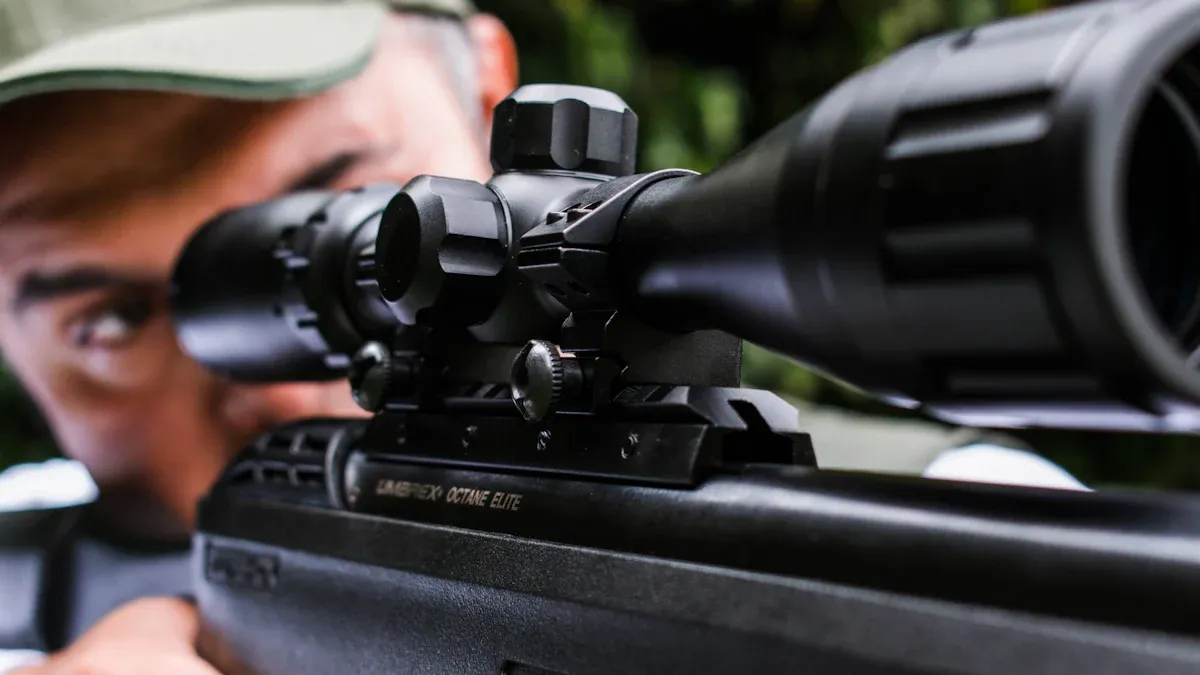
Ballistic apps and tools have revolutionized long-distance shooting by providing precise calculations for bullet trajectory. These tools allow shooters to input variables such as bullet weight, muzzle velocity, and environmental conditions to predict the point of impact. Insights from top Precision Rifle Series (PRS) shooters reveal that many professionals rely on scopes with advanced ballistic features. Minimalist reticles, favored by champions, simplify aiming by reducing visual clutter, enabling faster target acquisition.
Shooters should explore apps that offer customizable ballistic profiles and real-time adjustments. These tools enhance accuracy by accounting for factors like wind drift and bullet drop. Regular practice with these apps ensures familiarity and confidence during field use.
Tip: Pair ballistic apps with a rangefinder for precise distance measurements, especially when engaging targets beyond 500 yards.
Adjusting for Environmental Conditions
Environmental factors, such as wind and temperature, significantly affect long-distance shooting accuracy. Temperature variations can alter muzzle velocity, impacting bullet trajectory. Single-base powders, containing only nitrocellulose, exhibit greater stability across temperature changes compared to double-base powders with nitroglycerin. This stability ensures consistent performance in varying climates.
Wind is another critical factor. Shooters must learn to read wind direction and speed to adjust their aim accordingly. Using wind flags or observing natural indicators, like grass movement, can help estimate wind conditions. Practicing in diverse environments builds the skills needed to adapt quickly.
Note: Always test ammunition under similar conditions to those expected in the field to ensure reliable performance.
Breathing and Trigger Control Techniques
Proper breathing and trigger control are essential for precision shooting. Physiological studies highlight key differences between expert and novice shooters.
| Finding | Description |
|---|---|
| Skin Conductance | Experts show a gradual reduction in skin conductance before firing. |
| Heart Rate | A rebound increase in heart rate occurs post-shot for experienced shooters. |
| Cardiac Deceleration | Experts exhibit systematic pre-shot cardiac deceleration for better shots. |
| Breath Control | Timing the respiratory cycle improves stability during trigger pull. |
Shooters should exhale halfway and hold their breath briefly while squeezing the trigger. A smooth, consistent trigger pull minimizes movement and ensures accuracy. Developing these habits through dry-fire drills enhances muscle memory and confidence during live shooting.
Tip: Focus on a steady grip and controlled breathing to maintain stability, especially in high-pressure situations.
Mastering rifle scope techniques requires proper setup, precise adjustments, and consistent practice. A practical test demonstrated that shooters who adjusted scope knobs methodically achieved reliable performance.
| Practice Technique | Impact on Performance |
|---|---|
| Double-checking scope’s parallax | Minimizes shooter influence on dispersion |
| Consistent body position | Reduces variability in shot placement |
Shooters should focus on these methods to enhance accuracy and confidence in the field.
FAQ
What is the ideal distance for zeroing a rifle scope?
The ideal distance depends on the intended use. For hunting, 100 yards is common. Long-range shooters may prefer 200 yards or more for better accuracy.
How often should a rifle scope be re-zeroed?
Re-zeroing is necessary after transporting the rifle, changing ammunition, or experiencing environmental shifts. Regular checks ensure consistent accuracy in the field.
Can a rifle scope be used in low-light conditions?
Yes, scopes with larger objective lenses and illuminated reticles perform better in low-light conditions. These features enhance visibility and improve target acquisition during dawn or dusk.
Post time: Apr-23-2025