
Customizing a Picatinny Rail setup truly transforms a firearm. Shooters can precisely position a rifle scope for accuracy. They also attach a stable Rifle bipod for steady shots. This versatile Rail makes gear placement easy. Every Mount enhances the shooting experience across all applications.
Key Takeaways
- Picatinny rails offer a standard way to attach many firearm accessories. This helps shooters improve accuracy and control.
- Choosing the right rail material and accessories helps balance your firearm. This makes it easier to handle and use.
- Properly installing and maintaining your Picatinny rail is important. This ensures your gear stays secure and works well.
Understanding the Picatinny Rail System
What is a Picatinny Rail and Why is it Essential?
A Picatinny Rail, also known as MIL-STD 1913, provides a universal mounting system for firearm accessories. Before its creation, companies used their own attachment systems. This made it hard to switch accessories. The U.S. military needed a standard system for night vision and lasers. So, a team at the U.S. Army Picatinny Arsenal developed this rail. It became a military standard in 1995. Gary Houtsma, the lead designer, measured many existing rails. He then created an average design. This design features T-shaped grooves and uniform slot spacing. It allows for many different accessories.
Picatinny Rail vs. Weaver Rail: Key Differences
People often confuse Picatinny rails with Weaver rails. They look similar but have important differences. The Picatinny Rail has precise dimensions.
| Feature | Picatinny Rail (MIL-STD-1913) | Weaver Rail |
|---|---|---|
| Slot Width | 0.206″ (approx. 5mm) | 0.180″ (4.5mm) or 0.150″ (3.8mm) |
| Slot Spacing | 0.394″ (10mm) center-to-center | Not necessarily consistent center-to-center |
| Consistency | Consistent | Varies, can be inconsistent |
Picatinny slots are wider at 0.206 inches. They also have consistent spacing. Weaver rails have narrower slots, about 0.180 inches. Their slot spacing is not always the same. This means Picatinny accessories usually do not fit on Weaver rails. However, Weaver accessories often fit on Picatinny rails.
Core Benefits of Picatinny Rail Customization
Customizing with this rail offers many advantages. Its standardized design ensures wide compatibility.
“The Picatinny rail’s standardized design ensures compatibility with nearly all Picatinny-compatible accessories.”
This system is battle-proven. It accommodates a vast array of accessories.
- It ensures compatibility with almost all Picatinny-compatible accessories.
- It provides secure mounting, even for heavy items like scopes.
- Its government standard status guarantees accessory interchangeability.
- Uniform recoil slots allow flexible mounting along the entire rail.
Choosing the Right Picatinny Rail for Your Firearm
Types of Picatinny Rails and Their Applications
Shooters find many types of Picatinny rails available. Some rails are full-length, running along the entire top of a receiver. Others are short sections, perfect for specific accessory placement. Manufacturers use different materials for these rails. For standard use, 6061 T6 Aluminum offers a good mix of strength and light weight. This material works well for most hunting rifles and sport shooting. For heavy-duty tasks, like resisting strong recoil, manufacturers machine rails from solid steel or ultra-strong 7075 T6 Aluminum. Some specialized applications even use challenging materials like Inconel and titanium.
Factors to Consider When Selecting a Picatinny Rail
Selecting the right Picatinny Rail involves careful thought. First, consider the material. Steel rails offer great durability, but aluminum rails are lighter. High-quality 7075 alloy aluminum rails are hard and tough, performing like steel but with less weight. Next, think about firearm balance. Adding too many accessories, such as scopes, grips, and lights, makes a firearm bulky. This makes it harder to handle. Prioritize accessories that truly improve the shooting experience. Cantilever mounts are helpful. They extend forward, offering better eye relief for larger optics while keeping the firearm balanced.
Upgrading Factory Stocks with a Picatinny Rail
Many factory stocks come without accessory mounting points. Upgrading these stocks with a Picatinny Rail opens up a world of possibilities. You can attach short rail sections directly to the stock. This allows for bipods, sling mounts, or other accessories. Some stocks offer M-LOK or KeyMod slots. You can then attach Picatinny rail sections to these slots. This simple upgrade gives you more flexibility. It lets you customize your firearm for better performance and comfort.
Optimizing Your Picatinny Rail for Home Defense
Home defense situations demand quick thinking and reliable gear. A well-configured firearm can make all the difference. Customizing your setup for close-quarters engagement ensures you have the right tools exactly where you need them.
Essential Accessories for Close-Quarters Engagement
When things go bump in the night, every second counts. Your home defense firearm needs accessories that boost speed and effectiveness. A bright weapon light helps identify threats, while a laser provides rapid aiming in stressful situations. Compact red dot sights offer quick target acquisition, letting you get on target faster than traditional iron sights. Many people also find a vertical or angled foregrip useful. It gives them better control and stability, especially when moving through tight spaces. Think about what helps you react instinctively and confidently.
Strategic Placement of Lights and Lasers on Your Picatinny Rail
Proper placement of lights and lasers is not just about convenience; it is about performance. A poorly placed light can cast a shadow from your barrel, obscuring your view. To avoid this, consider these smart moves:
- Position the light as far forward on the handguard as practically possible. Ideally, it sits flush with the muzzle. This maximizes the arc of illumination and minimizes any barrel shadow.
- Mount the light high on the rifle, specifically in the upper right or left quadrant. This clever trick directs the barrel shadow downwards and to the opposite side, keeping your field of view clear.
- For rifles used with suppressors, employ cantilever or extended light mounts. These push the light even further forward. They treat the end of the suppressor as the effective muzzle, minimizing shadow.
An offset or extended M-LOK mounting system offers fantastic flexibility. It helps you find that perfect light position. You can place it anywhere around the handguard, even extending it beyond the barrel to banish shadows. For firearms with limited rail space or when using suppressors, a lightbar mount can be a game-changer. It extends the light further out, preventing or minimizing suppressor shadow. This also optimizes ergonomics and keeps your firearm sleek for storage.
Integrating Sling Mounts and Quick-Detach Solutions
A sling might seem simple, but it is a vital piece of home defense gear. It keeps your firearm secure and allows you to go hands-free if needed. Imagine needing to open a door or help a family member; a sling makes it possible. Ambidextrous sling mount solutions offer significant advantages:
- Extended Range of Motion: They provide over 180 degrees of movement for ambidextrous weapon control. This means you can maneuver your firearm freely, no matter which shoulder you use.
- Minimized Sling Snagging: These mounts reduce the likelihood of the sling getting caught on gear or obstacles. This is crucial when moving quickly through a cluttered home.
- Easy Shoulder Transition: They facilitate smooth and quick switching of the firearm between your weapon-side and reaction-side shoulders. This adaptability is key in dynamic home defense scenarios.
Quick-detach (QD) sling swivels and mounts are also excellent additions. They allow you to rapidly attach or remove your sling. This flexibility lets you adapt your setup instantly to the situation at hand.
Enhancing Performance for Competition with Your Picatinny Rail
Competitive shooting demands speed, precision, and flawless execution. Every second counts, and every movement matters. Customizing your firearm for competition means setting it up to perform at its peak, helping you shave precious milliseconds off your time and hit those targets with unwavering accuracy.
Ergonomic Setups for Rapid Target Acquisition
Competitive shooters know that a comfortable and efficient grip makes all the difference. Ergonomic setups help them quickly find and engage targets. Foregrips, for example, create a crucial second point of contact. This extra contact point greatly improves weapon manipulation. It also makes fluid target transitions much easier. Shooters find foregrips help them manage recoil and reduce muzzle rise. This leads to faster follow-up shots. They also minimize wrist strain and fatigue during long shooting sessions, allowing for sustained top performance. Angled foregrips are especially good. They promote a natural wrist position. This helps with quicker target transitions, particularly when shooters use the ‘thumb-over-bore’ method. Competitive shooters, like those in 3-Gun, use foregrips to boost their speed and accuracy. This is especially true when moving between targets and achieving faster follow-up shots.
Selecting Red Dot Sights and Magnifiers for Speed
Speed is king in competitive shooting, and red dot sights are a shooter’s best friend for rapid target acquisition. These sights offer a clear, uncluttered view, allowing shooters to focus on the target without aligning traditional iron sights. Different reticle types offer unique advantages for speed.
- The ACSS Vulcan reticle helps competitive shooters acquire the dot more effectively, even under stress. This design guides the eye quickly to the center.
- Holosun’s multi-reticle system, especially its circle dot configuration, is a solid choice for many competitive shooting disciplines. The circle helps frame the target quickly.
- Holosun also offers a Competition Reticle System (CRS). This system features a 2-MOA dot surrounded by an 8-, 20-, or 32-MOA outer ring. Manufacturers specifically designed this system for competition use.
While red dots excel at speed, magnifiers can also play a role. Shooters can flip them into place for longer shots, giving them the precision needed without sacrificing the red dot’s speed for close-range targets.
Utilizing Bipods and Foregrips for Enhanced Stability
Stability is key for accurate shots, especially when time is short. Foregrips and bipods offer different ways to achieve this stability.
“I noticed about a 15% improvement in my split times after finding the right foregrip position,” one competitive shooter told us. “It’s not magic, but it definitely helps me stay on target.”
Vertical AR-15 foregrips provide maximum leverage against recoil. This makes rapid follow-up shots much easier. They offer a familiar grip style for shooters with submachine gun backgrounds. Many even include hollow cores for storing small items. Angled AR-15 foregrips, on the other hand, excel in competitive shooting for quick target transitions. Their ergonomic design reduces fatigue, allowing shooters to perform at their peak over extended periods.
A vertical foregrip significantly impacts muzzle control. It creates rearward leverage, pulling the rifle firmly into the shoulder. This solid grip helps keep the muzzle tracking straight during rapid fire. Shooters spend less time re-acquiring the target after each round, leading to faster follow-up shots.
- Faster Target Transitions: Ergonomic designs allow for quicker and smoother movements between targets. This reduces the time needed to reposition a hand, which is crucial in dynamic shooting scenarios where speed is paramount. Shooters can acquire and engage multiple targets with greater efficiency.
- Recoil Management: Foregrips help mitigate recoil by providing a more stable shooting platform. Their grip angle and ergonomic design allow for better absorption and control of recoil forces. This results in improved shot placement and faster follow-up shots, regardless of the firearm’s caliber.
Many shooters and professionals report improvements in accuracy after adding a QD foregrip to their setup. Competitive shooters often cite faster target acquisition and reduced time between shots as key benefits.
- Vertical QD Foregrips: These are the traditional type, extending straight down. They provide a natural and firm handhold, improving control and stability, especially in rapid-fire situations. Tactical shooters often prefer them for effective recoil management.
- Angled QD Foregrips: Their slanted design allows for an angled hand position. This promotes a more natural wrist position, reducing strain and enhancing comfort over extended periods. Shooters who prefer an aggressive forward grip often favor them.
Bipods also offer immense stability for specific shooting stages. When a shooter needs to take precise shots from a prone or bench position, a bipod provides a rock-solid platform. This eliminates wobble and allows for maximum accuracy, ensuring every shot counts.
Maximizing Versatility for Hunting with a Picatinny Rail
Hunting often means facing unpredictable conditions. The sun might blaze at noon, then hide behind thick clouds by dusk. A hunter needs gear that adapts as quickly as the weather changes. Customizing a rifle for hunting means preparing for anything the wild throws your way.
Optics for Diverse Lighting Conditions on Your Picatinny Rail
Hunters know that light changes everything. A bright morning hunt needs one type of scope. A shadowy evening hunt demands another. The beauty of a well-equipped rifle is its ability to swap optics in a flash. For bright, open fields, a scope with high magnification helps spot distant game. When the sun dips low, a scope with a larger objective lens gathers more light. This makes dim targets appear clearer. Some hunters even use low-power variable optics (LPVOs). These scopes offer a wide field of view for close shots and can zoom in for longer distances. This adaptability ensures a hunter always has the right view, no matter the time of day or the weather.
Seamless Integration of Thermal and Night Vision Devices
Sometimes, the best hunting happens when the sun goes down. Thermal and night vision devices turn darkness into an advantage. These tools let hunters see game that hides in shadows or moves after dark. Attaching these advanced optics to a rifle is simple. Hunters use special mounts that secure the devices firmly.
Here are some common ways hunters attach thermal imagers:
| Mount Type | Description | Key Feature |
|---|---|---|
| Standard Mount | Rail-shaped mount with M6 screws | Requires screw tightening each time for attachment |
| Quick-Detach Dual-Pin Mount | MT3 quick-detach rail-shaped mount | Attaches/removes from rail in one second by flipping a lever |
Hunters also have other clever options for mounting their night vision or thermal gear:
- Quick-release mount: This mount lets hunters react fast. They can quickly turn their sight into a monocular for scanning. These mounts are also compact.
- Permanent mounting bar: This option offers a super strong hold to the barrel. It is very secure, though it looks a bit bigger on the rifle.
- Swivel quick-release bracket: This bracket uses a prism design. It handles heavy optical sights well. Hunters can swap sights quickly without losing their zero. This means no need to re-zero the rifle.
Practical Carrying Solutions and Sling Attachments
Long treks through the woods demand a comfortable way to carry a rifle. A good sling makes all the difference. It keeps the rifle secure and frees up a hunter’s hands. This allows them to climb, use binoculars, or carry other gear.
Choosing the right sling means thinking about comfort and durability:
- Wider slings spread the rifle’s weight better. This reduces shoulder strain, which is vital for long walks.
- Hunters pick materials that resist moisture, UV rays, and bad weather. This ensures the sling lasts through many seasons.
- Two-point slings are very flexible. They help hunters aim steadily and feel comfortable for long carries. They work great for most hunting trips.
- Convertible slings offer maximum flexibility. Hunters can adjust them to work as single-point or two-point slings.
Many great slings exist for hunters who spend hours in the field:
- The padded Blue Force Gear Vickers Sling offers extra comfort for extended use.
- Traditional leather slings can feel comfortable for hours.
- The RedKettle Quick Release Rifle Sling M19 allows secure, hands-free carrying. Hunters can wear it across the chest or on the back, even with a backpack. This makes it perfect for mountain hunting.
- The Ultimate Firearm Sling uses non-slip thermoplastic. It holds the rifle securely on the shoulder, even on steep hikes. Hunters can even turn it into a ‘three-quarter backpack’ for super secure carry.
- The Quake Claw Sling has a padded shoulder strap with a non-slip surface. It keeps the rifle firmly on the shoulder without slipping or rolling.
Attaching a sling correctly is just as important as choosing the right one:
- Hunters always make sure the sling attaches securely to the rifle mount.
- They adjust the sling’s length properly. This allows smooth transitions between carrying and shooting.
- Hunters can choose fixed mounts for toughness and security. Quick-detach (QD) mounts offer more flexibility.
- Placing one sling mount near the stock and another near the handguard helps balance the rifle. It also distributes weight better.
- Hunters test different sling mount positions. They find what works best for their shooting style.
Picatinny Rail Installation Best Practices and Maintenance
Secure Mounting Techniques for Reliability
Imagine your favorite accessory wiggling loose right when you need it most. That is a real bummer! Proper mounting makes sure your gear stays put. When an accessory feels loose on your Picatinny Rail, you need to fix it. First, take the wobbly accessory off the rail. Next, look closely at its mounting parts for any damage. Make sure all screws are tight, just like the maker says. Finally, use a thread locker. This special liquid keeps screws from shaking loose again.
Understanding Torque Specifications and Essential Tools
Getting your accessories tight enough, but not too tight, is a bit like baking a cake. You need the right recipe! Torque specifications tell you exactly how much to tighten screws. This prevents damage and keeps things secure. Experts often suggest using blue thread locker for the bases when mounting accessories. This helps them stay put.
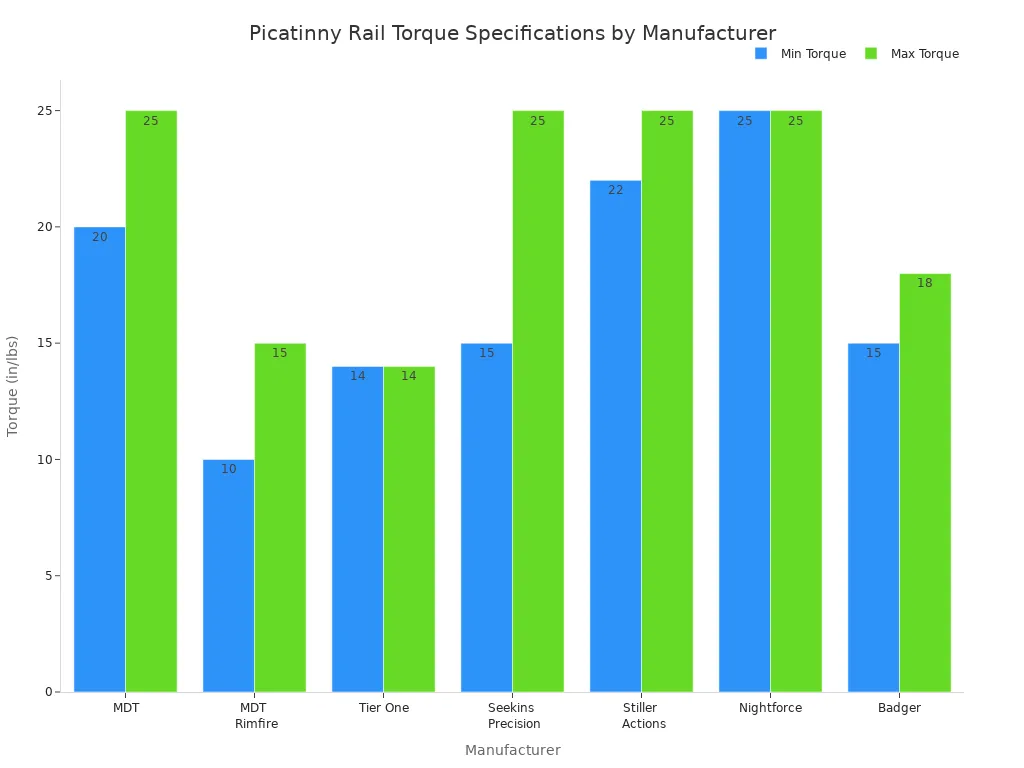
Here is a quick look at some common torque settings for your Picatinny Rail:
| Manufacturer | Picatinny Rail Torque (in/lbs) |
|---|---|
| MDT | 20-25 |
| MDT Rimfire | 10-15 |
| Tier One | 14 |
| Seekins Precision | 15-25 |
| Stiller Actions | 22-25 |
| Nightforce | 25 |
| Badger | 15-18 |
For scope rings, which hold your scope to the base, experts generally recommend 35-55 in/lbs. But remember, screw type and material can change this. A torque wrench is your best friend here. It helps you tighten screws to the exact right amount. For small 6-48 screws, 15-20 in-lbs works well if they are clean and without Loctite.
Regular Inspection and Cleaning for Longevity
Your firearm works hard for you. Give it a little love back! Regularly check your Picatinny rail and all its attached goodies. Look for any loose screws or signs of wear. Dirt and grime can build up, especially after a fun day at the range or out hunting. A quick wipe-down keeps everything sparkling and working smoothly. This simple routine helps your gear last longer and perform better.
A well-customized Picatinny Rail setup truly elevates a shooter’s experience. It boosts performance and makes every shot count. Remember to choose accessories wisely, matching them to your specific needs. Always prioritize responsible firearm handling, especially when modifying your gear. Safety comes first.
FAQ
What makes a Picatinny rail different from a Weaver rail?
Picatinny rails feature consistent, wider slots. Weaver rails have narrower, inconsistent slots. This means Picatinny accessories often do not fit Weaver rails.
Post time: Oct-24-2025