
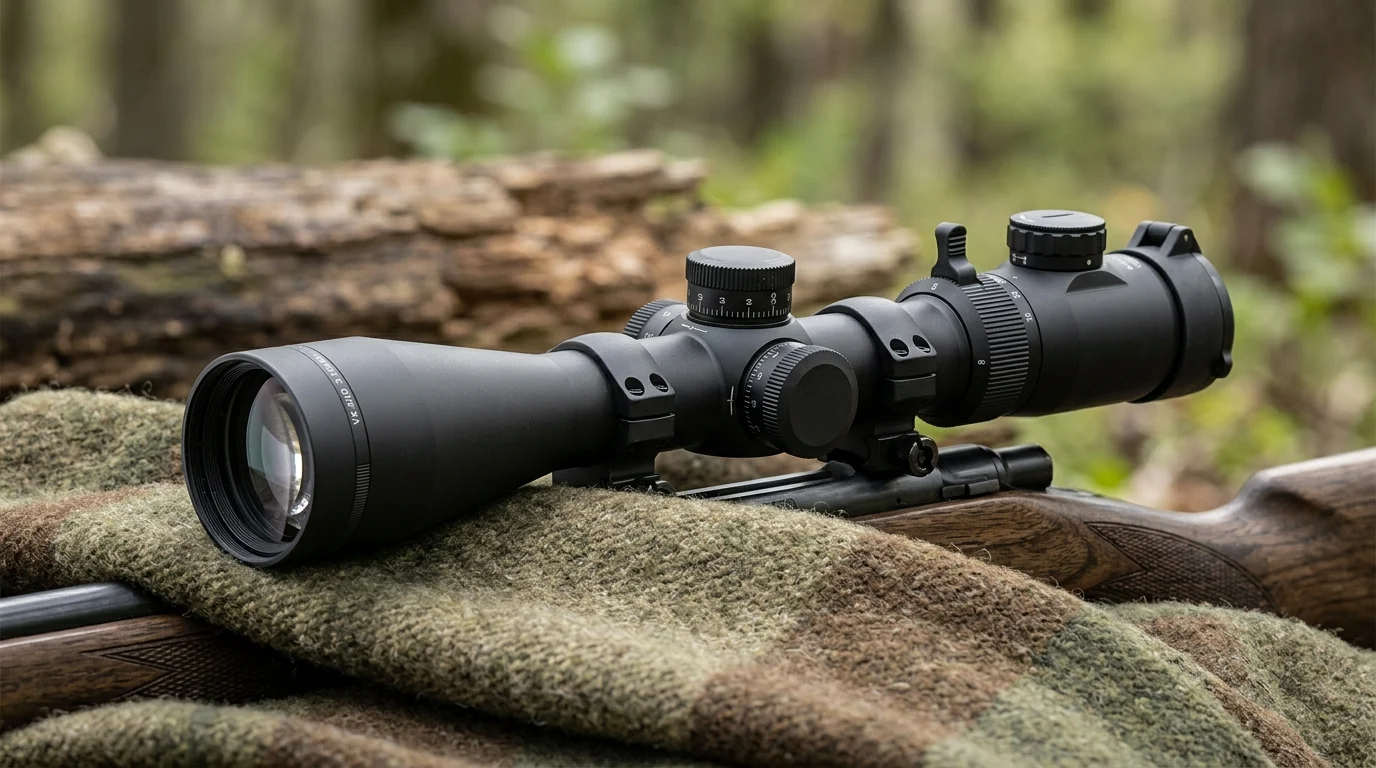
A scope’s glass may look sharp at the counter, but the reticle system determines how dependable your aiming references are when a deer appears at distance. First focal plane and second focal plane designs behave very differently as magnification changes, and that difference can affect holdovers, wind calls, speed, and confidence in the field. For hunters working inside 300 yards, simplicity and visibility may matter most; for ridge-line shots past 400 yards, accurate subtensions at any power can be a major advantage. This guide breaks down how each reticle works, where each excels, and how to choose based on real hunting conditions rather than optical jargon.
Why FFP vs SFP Matters for Hunting
The modern hunting landscape is flooded with optical jargon, leaving many shooters scratching their heads at the sporting goods counter. Among the most fiercely debated topics around the campfire is the choice between First Focal Plane (FFP) and Second Focal Plane (SFP) reticles. Understanding this mechanical distinction is critical to preventing a heartbreaking miss when a trophy animal finally steps into the clearing.
Choosing the right rifle scope is not just about glass quality or a broad 4x to 16x magnification range; it is about how the reticle behaves when the pressure is on, the adrenaline spikes, and the magnification ring starts spinning.
First Focal Plane vs Second Focal Plane Basics
The fundamental difference between these two systems comes down to where the etched reticle is placed within the erector tube. In an FFP scope, the reticle is placed ahead of the magnification lenses. As a result, the reticle visually grows and shrinks as the user adjusts the magnification. This mechanical design means that the reticle's subtensions—the hash marks used for windage and elevation holds—remain mathematically accurate at 100% of the magnification settings. If a hash mark represents 1 mil (roughly 3.6 inches at 100 yards), it will equal exactly 1 mil whether the scope is dialed to 4x, 10x, or 16x.
Conversely, an SFP reticle sits behind the magnification lenses. It remains a static, constant size to the shooter's eye regardless of the zoom level. Because the target image grows but the reticle does not, the spacing between the hash marks only represents true ballistic values at one specific magnification setting—almost always the maximum power. If a shooter dials down to half-power to widen their field of view, those same hash marks represent double the original distance, requiring extra mental math on the fly.
| Feature | First Focal Plane (FFP) | Second Focal Plane (SFP) |
|---|---|---|
| Reticle Location | Front of erector tube | Rear of erector tube |
| Subtension Accuracy | 100% accurate across entire zoom range | Accurate only at 1 specific setting (usually max) |
| Visual Reticle Size | Scales proportionally (shrinks/grows) | Remains 100% static to the eye |
| Typical Use Case | Long-range (400+ yds), PRS, tactical | Short to mid-range (0-300 yds), dense timber |
| Average Cost Premium | 15% to 30% higher | Baseline cost |
Important Note on Turret Dialing: For hunters who prefer dialing their elevation turrets to a specific distance rather than using reticle holdovers, the FFP versus SFP distinction is far less critical. When dialing the turret and aiming strictly with the center crosshair, both systems work equally well at any magnification.
Mule Deer Ridge-Line Example
Imagine glassing a steep, wind-swept ridge and spotting a mature mule deer bedded down at exactly 450 yards. For a standard 6.5 Creedmoor 143-grain load, this distance requires roughly 48 inches (or 3.0 Mils) of elevation holdover. Because the animal is alert and preparing to stand, there is no time to dial the elevation turret; the shooter needs a precise, rapid elevation holdover. With an FFP scope, the hunter can dial the magnification down to an optimal 8x to keep a wide 12- to 15-foot field of view, hold exactly on the third hash mark (3 Mils) for elevation, and squeeze the trigger with absolute confidence.
If that same hunter were using a 4-16x SFP scope and relying on reticle holdovers, forgetting to crank the magnification all the way up to the calibrated 16x setting could easily result in a miss. At 8x magnification (exactly half power), that third hash mark on the static reticle actually represents double the true elevation shift (6.0 Mils instead of 3.0 Mils). Holding on that mark would likely send the bullet 45+ inches over the mule deer's back.
Key FFP vs SFP Trade-Offs
While FFP scopes offer a distinct ballistic advantage for holdovers beyond 300 yards, they carry trade-offs that can complicate a hunt if deployed in the wrong environment. To maximize effectiveness, the optic must be matched carefully to the conditions and distances you expect to face in the field.
Reticle Visibility and Magnification
The primary trade-off with FFP optics revolves around low-power visibility. In high-magnification FFP scopes (e.g., 5-25x or 4-16x)—particularly those featuring complex Christmas-tree designs—the reticle crosshairs can thin out to a nearly invisible 0.05 MILs at the lowest power. Without bright electronic illumination, fine FFP lines easily blend into dark backgrounds, making fast target acquisition incredibly difficult during the crucial first and last 30 minutes of legal shooting light. Conversely, at maximum magnification, the center dot might swell to cover 0.25 to 0.5 MOA (0.25 to 0.5 inches at 100 yards), potentially obscuring tiny targets.
SFP scopes completely bypass this sizing dilemma. Because the reticle maintains a bold, constant thickness (often around 0.15 to 0.25 MOA), it remains highly visible at every point on the magnification dial. This allows shooters to confidently secure their optic in a reliable mount and comfortably leave their scope on the lowest magnification setting while hiking, knowing the crosshairs will be instantly visible if a sudden opportunity arises.
Eastern Whitetail Woods Example
Picture a freezing November morning in the dense, tangled timber of the Eastern whitetail woods. Visibility is limited to a maximum of 50 yards, and the ambient light is struggling to break through the heavy canopy. Suddenly, a heavy-horned buck chases a doe through a narrow shooting lane at a mere 35 yards.
In this heart-pounding scenario, the hunter has roughly 1.5 to 2.0 seconds to shoulder the rifle, find the target, and fire. An SFP scope set to 3x magnification presents a thick, bold crosshair that naturally draws the eye to the center, allowing for a swift and ethical shot.
How to Choose the Right Reticle
Selecting the perfect hunting scope comes down to understanding where and how the chase unfolds. A reticle is the hunter's direct interface with the target; getting it wrong often means squinting at a vanishing crosshair just as a trophy buck steps into the clearing.
Match Scope Type to Hunting Style
The debate between First Focal Plane (FFP) and Second Focal Plane (SFP) optics hinges entirely on the environment. According to the National Shooting Sports Foundation (NSSF), ethical hunting requires precise shot placement, which demands an optic tailored to the specific terrain.
- SFP for Brush and Timber: If the hunt involves stalking through dense woods where shots rarely exceed 200 yards, an SFP hunting scope is the undisputed champion. The crosshairs remain thick and highly visible at low magnification, ensuring rapid target acquisition when seconds count.
- FFP for Open Plains and Mountains: For hunters glassing across canyons or taking long-range shots at antelope, FFP optics shine. Because the reticle scales with magnification, the holdover marks remain perfectly accurate at any zoom level, eliminating the need to perform complex ballistic math on the fly.
Field-Based Decision Matrix
To remove the guesswork from upgrading a hunting scope, use this quick reference matrix to match the optic to the expedition.
| Hunting Environment | Typical Engagement Distance | Recommended Reticle Type | Key Advantage |
|---|---|---|---|
| Dense Woods / Brush | 50 – 150 yards | SFP | Bold crosshairs at low power for fast, reactive shots. |
| Western Plains | 200 – 500+ yards | FFP | Accurate windage and elevation holdovers at any magnification. |
| Mixed Terrain | 100 – 300 yards | SFP (with illuminated dot) | Versatile visibility without the reticle shrinking at 3x or 4x zoom. |
| Varmint / Predator | 100 – 400 yards | FFP | Precise sub-tensions for small targets at varying distances. |
By aligning the optic's focal plane with the physical environment, hunters ensure their equipment works seamlessly with them, rather than against them, when the critical moment finally arrives.
Key Takeaways
- Choose an FFP scope if you regularly use reticle holdovers for wind or elevation at varied magnification settings.
- Choose an SFP scope for most 0-300 yard hunting where a bold, consistent reticle and lower cost are priorities.
- Remember that SFP reticle subtensions are usually accurate only at one magnification setting, commonly maximum power.
- Use FFP for longer shots around 400 yards and beyond, where accurate mil or MOA holds can prevent costly misses.
- If you dial elevation turrets and aim with the center crosshair, the FFP versus SFP choice becomes much less critical.
- Expect comparable FFP scopes to cost about 15% to 30% more than SFP models.
Frequently Asked Questions
What is the main difference between FFP and SFP scopes?
An FFP reticle changes size as magnification changes, keeping holdover marks accurate at every zoom level. An SFP reticle stays the same visual size, so its hash marks are usually accurate only at one set magnification, often maximum power.
Is FFP better for long-range hunting?
Yes, FFP is usually better for longer shots, especially around 400 yards and beyond, because windage and elevation holds remain accurate at any magnification. This helps when you need to adjust quickly without extra math.
When is an SFP scope a better choice?
SFP is often better for short to mid-range hunting, especially inside 300 yards or in dense timber. The reticle stays bold and easy to see at low magnification, and SFP scopes are usually more affordable.
Does FFP matter if I dial my turret instead of holding over?
Not as much. If you dial elevation on the turret and aim with the center crosshair, both FFP and SFP scopes work well at any magnification because you are not relying on reticle subtensions.
Why can SFP holdovers be confusing?
In an SFP scope, the reticle marks are calibrated at one magnification. If you reduce power for a wider field of view, those same marks represent different ballistic values, which can require quick mental math under pressure.
Post time: Jul-31-2026