
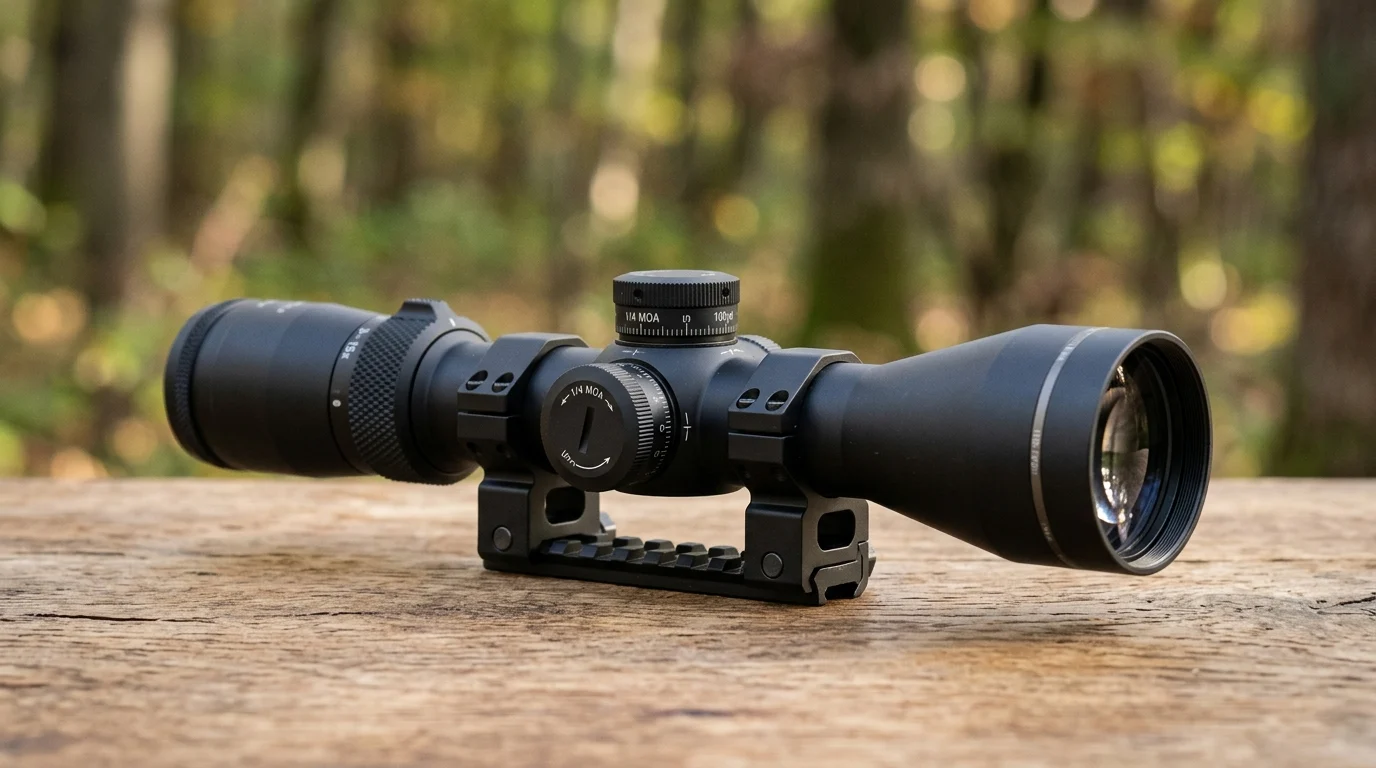
A hunting scope choice can look simple until the shot is uphill, the animal is moving, and your magnification ring is nowhere near where you practiced. The debate between first focal plane and second focal plane optics matters because it changes how your reticle behaves under pressure: one scales with magnification, the other stays visually constant. That difference affects holdovers, low-light visibility, close-range speed, and long-range confidence. This guide breaks down how each system works in real hunting conditions, when the added math consistency of FFP is worth it, and why the traditional SFP scope still remains a practical choice for many field shots.
FFP vs SFP Scope Basics
Stepping into the optic aisle to select a rifle scope often feels like decoding a secret language. Among the most hotly debated acronyms in the hunting community are FFP (First Focal Plane) and SFP (Second Focal Plane). While both systems successfully magnify a target, they handle the reticle in fundamentally different ways. Understanding this mechanical divergence is a crucial step toward ensuring a clean, ethical shot, whether the quarry is standing broadside at 50 yards or bedded down at a distant 500 yards.
What FFP and SFP Reticles Mean
At its core, the distinction lies in where the reticle sits inside the optic tube relative to the internal erector lenses. A First Focal Plane reticle is physically placed at the front of the erector assembly. As the shooter cranks up the magnification ring, the reticle zooms in right alongside the target image. Conversely, a Second Focal Plane reticle sits behind the magnification lenses, closer to the ocular lens. Because of this rearward placement, no matter how much the target image enlarges when zooming in, the crosshairs maintain the exact same physical size to the human eye.
It is important to note that focal plane is distinct from reticle design; a simple duplex reticle in an FFP scope offers no more holdover utility than an SFP duplex. The long-range advantages of FFP depend entirely on having a calibrated MOA, MRAD, or BDC reticle.
Why Reticle Position Matters for Hunters
This internal geometry drastically alters the visual shooting experience in the field. For decades, the undisputed standard hunting optic was an SFP 3-9x40mm. It dominated because hunters rarely dialed turrets for windage or elevation, preferring a simple point-and-shoot approach where a thick, highly visible crosshair was paramount. However, as modern rifle ballistics improved and engagement distances stretched beyond 400 yards, the dynamic scaling of an FFP reticle began turning heads. The position of that etched glass dictates whether a hunter must perform on-the-fly mental math under pressure, or if they can simply trust their hash marks regardless of where the zoom ring is set.
Key Hunting Scope Comparison Points
Comparing these two optical designs reveals distinct operational advantages that directly impact field performance. The choice ultimately dictates how a hunter interacts with their equipment under the stress of a ticking clock, challenging weather, and fading light.
| Feature | First Focal Plane (FFP) | Second Focal Plane (SFP) |
|---|---|---|
| Reticle Size | Changes dynamically with magnification | Remains visually constant |
| Holdover Math | Consistent at all magnification levels | Requires proportional math below max magnification |
| Low-Light Visibility | Can be faint at low magnification (unless illuminated) | Excellent at all magnification levels |
| Ideal Range | Open country and extended ranges | Brush, timber, and moderate ranges |
Reticle Scale, Holdovers, and Magnification
The most significant advantage of an FFP optic is the mathematical consistency of its sub-tensions. Because the reticle grows and shrinks in perfect proportion with the target, a 2 MOA (Minute of Angle) holdover represents exactly 2 MOA at 5x, 10x, or 25x magnification. This allows shooters to confidently use their hash marks for bullet drop compensation without maxing out the zoom ring.
In an SFP scope, those same holdover marks are typically calibrated to match the target perfectly only at the highest magnification setting. If an SFP optic is set to 5x on a 10x maximum scope, a 2 MOA hash mark suddenly represents 4 MOA on the target. Applying these proportional calculations requires knowing the exact magnification ratio and is highly prone to error under field pressure, especially when game is moving. Furthermore, some modern SFP scopes feature secondary true-magnification calibration marks to assist with mid-range holds.
However, there are two major caveats to the FFP advantage. First, if a hunter uses modern, finger-adjustable zero-stop turrets to dial for elevation and windage, the FFP reticle-scaling advantage is largely neutralized, making an SFP scope equally viable for long-range precision work. Second, because FFP reticles grow dynamically with magnification, they can appear excessively thick and obscure small targets or vital zones at very high zoom levels—a meaningful precision trade-off that SFP scopes avoid.
Low-Light Visibility and Field Use
Traditional FFP scopes carry a notorious drawback in the deep woods: low-light visibility. When dialed down to minimum magnification, a standard FFP reticle shrinks so much that it can become practically invisible against dark timber or heavy brush at dusk. While modern FFP hunting reticles often mitigate this issue by incorporating thicker outer posts or daylight-bright illumination, this creates a reliance on battery power. If the battery dies during a remote backcountry hunt, the reticle may be lost in the shadows.
Conversely, an SFP reticle is immune to this shrinking effect. It remains bold and easy to acquire in the final 15 minutes of legal shooting light without requiring any power source.
Regardless of which optical system is chosen, a rock-solid foundation is non-negotiable. Securing the scope with a precision-machined Rail and a heavy-duty Mount ensures that the optic holds zero flawlessly through the brutal recoil of heavy magnum hunting calibers, allowing either focal plane design to function as intended.
How to Choose the Right Scope System
No single optic conquers every environment perfectly. The ultimate purchasing decision boils down to the specific terrain, typical engagement distances, and the hunter's preferred methodology for taking the shot in their local hunting grounds.
Best Uses for FFP and SFP Scopes
Hunters prowling dense eastern hardwood forests, mountain timber, or stalking through thick brush rarely need extreme magnification. For these rapid, sub-200-yard encounters, an SFP scope shines brightly. Its thick crosshairs allow for lightning-fast target acquisition when a feral hog or whitetail bolts through the shadows.
On the other hand, western hunters chasing mule deer across wide-open canyons, or those hunting vast agricultural edge habitats, benefit immensely from FFP systems.
Key Takeaways
- Choose an SFP scope for most woods, brush, and moderate-range hunting where fast target acquisition and a consistently visible reticle matter most.
- Choose an FFP scope when you expect variable magnification and need accurate MOA, MRAD, or BDC holds at any power setting.
- Remember that most SFP reticle subtensions are correct only at one calibrated magnification, often the highest setting.
- Use illumination or a bolder reticle design if selecting an FFP scope for low-light hunting conditions.
- Do not judge a scope by focal plane alone; reticle design, glass quality, turret reliability, and field practice are equally important.
Frequently Asked Questions
Is FFP or SFP better for most deer hunting?
For typical deer hunting inside 300 yards, an SFP scope is often simpler and faster because the reticle stays bold and visible at any magnification, especially in timber or low light.
When does an FFP hunting scope make sense?
FFP is most useful for open-country hunts, variable shot distances, and longer ranges where you rely on MOA, MRAD, or BDC holdovers without keeping the scope on one exact magnification.
Are SFP holdover marks always accurate?
No. On most SFP scopes, reticle holdover marks are accurate only at a specific magnification, often maximum power. At lower power, you must adjust the math or dial instead.
Why can FFP reticles be harder to see in low light?
Because the reticle shrinks as magnification decreases, fine FFP crosshairs can become thin at low power. Illumination or a well-designed hunting reticle can help.
Does FFP automatically make a scope better for long range?
Not by itself. FFP only adds practical value when paired with a calibrated MOA, MRAD, or BDC reticle and when the hunter knows the rifle’s trajectory and wind holds.
Post time: Jul-31-2026