
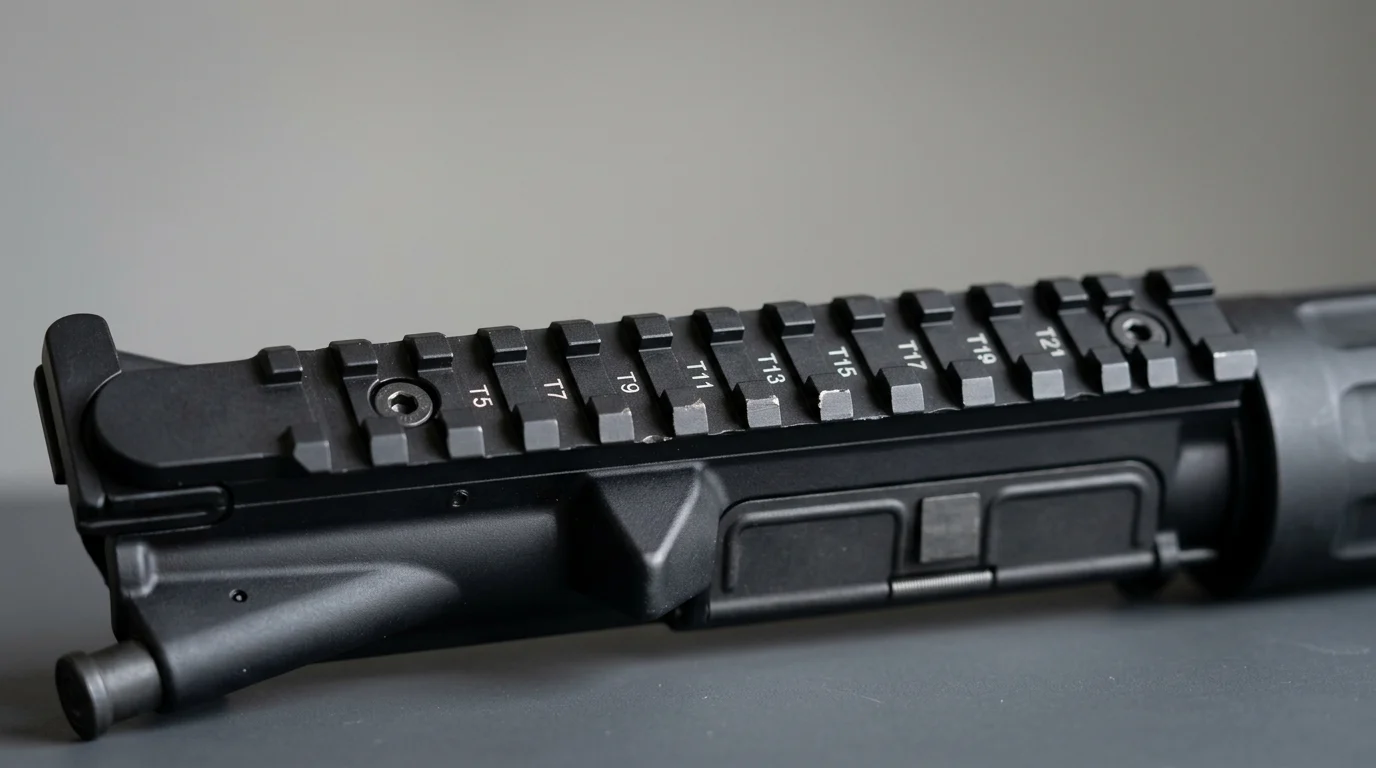
The accessory market is moving fast, but one mounting standard continues to anchor serious setups: the rugged, toothed rail interface trusted for optics, grips, lights, and mission-critical mounts. In 2026, buyers are facing heavier digital optics, integrated rangefinders, and more demanding field requirements, making rail geometry and material quality more important than ever. This guide explains why Picatinny remains the commercial baseline, how its MIL-STD-1913 dimensions affect fit and repeatability, and what to look for when comparing accessories. Whether you are configuring a range rifle or a duty-ready platform, the right rail and mount choices can directly influence stability, zero retention, and long-term reliability.
Why the Picatinny Rail Remains the Commercial Baseline
Even as the industry adopts sleek, ultra-light negative-space mounting systems like M-LOK and KeyMod for handguards, the classic Picatinny platform remains the foundational standard for heavy-duty applications. Originally standardized in the mid-1990s as MIL-STD-1913, this rugged, toothed track provides exceptional modularity. Armorers and enthusiasts alike rely on it to secure an extensive range of accessories to their platforms.
While newer interfaces excel at reducing weight, Picatinny remains preferable for mounting heavy optics and devices requiring strict return-to-zero repeatability. Its sheer ubiquity ensures continued relevance well into 2026. Understanding this enduring position requires examining its precise geometry and the modern market trends driving its evolution.
Core Picatinny Rail Specifications
The reliability of any mounting platform lies in its strict dimensions. The military specification dictates a precise slot width of 0.206 inches (5.23 mm) and a center-to-center slot spacing of 0.394 inches (10.01 mm). This exactness prevents heavy optics from sliding forward under recoil. It is also crucial to note compatibility caveats: while Weaver accessories typically fit Picatinny rails, the reverse is rarely true due to narrower Weaver slots (0.180 inches). Furthermore, this cross-compatibility is not flawless. For example, a Weaver accessory with a smaller cross-bolt may shift back and forth under recoil inside the wider 0.206-inch Picatinny slot, preventing a true return-to-zero.
The 45-degree angled facets on the sides provide a clamping surface that self-centers attachments. Whether securing a heavy thermal unit or a quick-detach flashlight, these core specifications help maintain zero with mechanical repeatability that friction-lock systems often cannot match.
2026 Market Forces Shaping Accessory Demand
As the industry moves through 2026, the demand for rail space is increasingly driven by specific, observable technological advancements. Shooters are now attaching heavier, tech-laden devices such as thermal-digital fusion optics, AI-driven ballistics units, and integrated laser rangefinders. This shift demands platforms capable of handling increased payloads without flexing or losing zero.
Manufacturers are responding to these concrete developments by machining rails from advanced alloys rather than standard extrusions. This ensures that the extra weight of modern digital optics does not compromise balance or structural integrity, keeping the traditional rail system highly relevant in an increasingly high-tech landscape.
How Buyers Should Compare Picatinny Rail Accessories
Navigating the accessory market requires evaluating hardware based on hard metrics rather than marketing terminology. Shooters must focus on practical specifications and material science to ensure their setup performs reliably.
Comparing options effectively means understanding that manufacturing tolerances vary. The right choice depends entirely on whether the gear is destined for casual range use or rigorous field deployment.
Key Specs for Optics, Grips, and Mounts
When evaluating a high-end optic, the interface is just as critical as the glass. A precision mount must feature recoil lugs that properly engage the slot width to prevent shearing. Torque specifications are equally vital. While a quality ring set typically requires 15 to 20 in-lbs of torque for the caps and base nuts usually require 25 to 45 in-lbs, these figures are illustrative. Always follow specific manufacturer guidelines and use a calibrated torque wrench with proper threadlocker. Failure to do so can lead to dangerous installation errors, including over-torquing, stripped threads, or permanent rail deformation.
The same scrutiny applies to stability tools and grips. A dependable bipod must lock into the rail with a cross-bolt design rather than a simple friction clamp, ensuring it can withstand forward loading without slipping. For grips, users must choose between vertical, angled, and hand-stop configurations based on ergonomic needs. Regardless of the accessory, practical mounting advice dictates verifying full slot engagement and confirming return-to-zero capabilities with quick-detach mounts.
The table below provides illustrative material specifications; exact tensile yield strengths and costs will vary by manufacturer and market conditions.
| Material Type | Approx. Tensile Yield Strength | Approx. Cost Band | Best Application |
|---|---|---|---|
| Polymer / Glass-Filled | ~15,000 psi | $15 – $35 | Lightweight grips, casual use |
| 6061-T6 Aluminum | ~40,000 psi | $40 – $85 | Standard mounts, bipods |
| 7075-T6 Aluminum | ~73,000 psi | $90 – $200+ | Precision optics, heavy recoil |
| Titanium / Steel | ~100,000+ psi | $150 – $300+ | Extreme duty, structural rings |
Trade-Offs Between Durability, Weight, and Cost
The standard manufacturing triangle of durability, weight, and cost forces shooters to make calculated decisions. Opting for 7075-T6 aluminum offers nearly double the tensile yield strength of 6061-T6, making it highly resilient for heavy-duty use, though it commands a premium price.
Conversely, high-density polymers are cost-effective and light, making them ideal for vertical foregrips, angled grips, or wire-management panels. However, utilizing polymer for a primary optic mount often leads to a wandering zero, as the material can flex under the substantial recoil forces generated by heavy centerfire cartridges.
Practical Steps for Choosing the Right Picatinny Rail Accessory
Selecting the right equipment is only half the process. The realities of the modern supply chain dictate which products reliably make it to the retail shelf and perform as expected.
A thorough vetting process separates reliable manufacturers from inconsistent suppliers, ensuring that the accessories perform as advertised in demanding environments.
Fit, Compliance, Sourcing, and Logistics Checks
Sourcing the right gear requires rigorous checks, including verifying that manufacturers use proper MIL-STD-1913 slot gauging during quality control. When sourcing parts, enthusiasts should look for specific anodizing requirements, such as MIL-A-8625 Type III hardcoat, which indicates a higher tier of manufacturing. Availability and lead times for these premium batches can fluctuate significantly based on global aluminum supply chains and manufacturing capacity.
Compliance and logistics are also major considerations for the modern shooter. International shipments of certain tactical components may trigger strict export scrutiny, meaning some high-end accessories might be restricted in your region. Furthermore, a reputable brand should demonstrate stringent quality control to guarantee consistent slot geometry and minimal defect rates, ensuring the product you receive matches the one tested in the factory.
Key Takeaways
- Choose true MIL-STD-1913 Picatinny rails when mounting heavy optics or devices that require repeatable zero.
- Verify the 0.206-inch slot width and 0.394-inch slot spacing before relying on an accessory for precision use.
- Use caution with Weaver accessories on Picatinny rails because smaller cross-bolts can shift under recoil.
- Prioritize mounts with properly fitted recoil lugs and follow the manufacturer’s torque specifications during installation.
- Consider advanced alloy or precision-machined rails for heavier 2026 accessories such as thermal optics and integrated rangefinding devices.
Frequently Asked Questions
Why is the Picatinny rail still widely used in 2026?
Picatinny remains popular because its MIL-STD-1913 geometry offers strong mechanical engagement, broad accessory compatibility, and reliable repeatability for heavier optics, lights, lasers, and digital devices.
What are the key Picatinny rail dimensions buyers should know?
A true Picatinny rail uses a 0.206-inch slot width and 0.394-inch center-to-center slot spacing. These dimensions help accessories lock consistently and resist movement under recoil.
Are Weaver accessories compatible with Picatinny rails?
Often, yes, Weaver accessories can fit Picatinny rails. However, Weaver cross-bolts may be smaller, which can allow movement inside the wider Picatinny slot and reduce return-to-zero reliability.
Is Picatinny better than M-LOK or KeyMod?
It depends on the application. M-LOK and KeyMod reduce weight on handguards, while Picatinny is often preferred for heavy optics, precision mounts, and accessories needing rigid, repeatable positioning.
What should I check before buying a Picatinny optic mount?
Check rail compatibility, recoil lug engagement, clamp quality, recommended torque values, material strength, and whether the mount supports repeatable zero after removal and reinstallation.
Post time: Jul-09-2026