
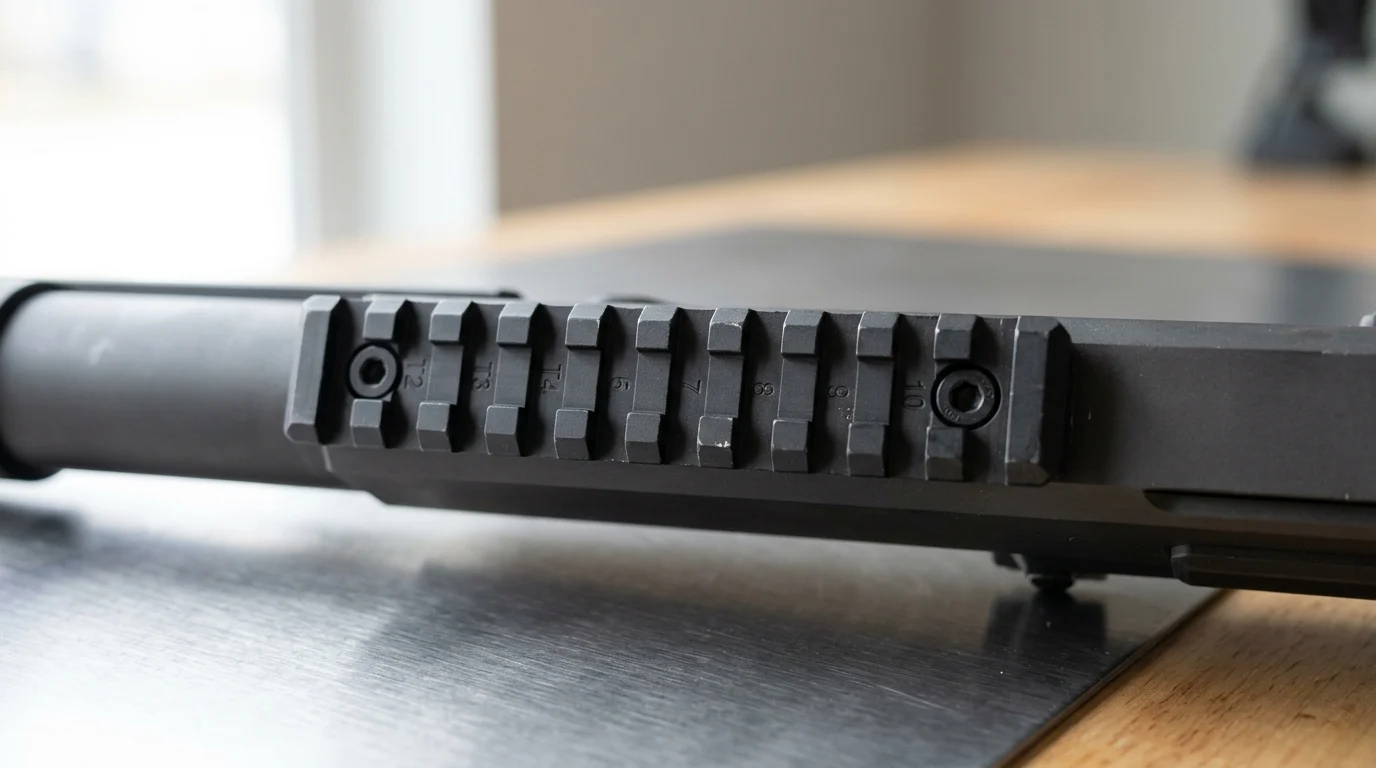
A Picatinny rail may look like a basic machined accessory, but export regulators can view it through a much different lens. For manufacturers, the risk is not only the part’s geometry; it is the platform it fits, the customer it serves, and the way it is described in sales materials. Under U.S. export rules, a rail intended for a sporting rifle may be treated differently from one designed around controlled military equipment. This article explains how ITAR and EAR classification, “specially designed” analysis, marketing language, and penalty exposure can turn an ordinary international order into a serious compliance decision.
How Picatinny Rail Export Rules Affect a Simple Component
To the untrained eye, a Picatinny rail is a simple piece of geometry—a standard 0.835-inch-wide bracket that revolutionized how shooters attach tactical gear. But to federal export agents, this hardware accessory can be subject to strict export controls.
Manufacturers producing these components sometimes assume that because the part lacks moving pieces or explosive powder, it automatically gets a free pass across international borders. That assumption can lead to severe regulatory violations, transforming standard international orders into complex compliance issues.
Key Export Definitions for Picatinny Rails
Navigating export controls starts with understanding two distinct regulatory frameworks: the International Traffic in Arms Regulations (ITAR) and the Export Administration Regulations (EAR). A scope base rail might seem like a universal commodity, but its classification depends on specific United States Munitions List (USML) and Commerce Control List (CCL) categories. Jurisdiction often hinges on whether the item is "specially designed"—a specific legal test under both regimes determining if a part is uniquely modified for a controlled application.
If a manufacturer explicitly designs a rail system to fit a defense article, it may fall under ITAR jurisdiction. Conversely, components meant for standard sporting rifles usually land under the EAR. The stakes for getting this wrong are substantial: as of 2024, EAR civil penalties can reach up to $364,992 per violation or twice the value of the transaction, while ITAR civil penalties can exceed $1.3 million per violation. Both maximums are adjusted annually for inflation.
Why Manufacturers Overlook Picatinny Rail Controls
Why do experienced machine shops and accessory brands get tripped up? Mostly, it is the "simple bracket" fallacy. Because a rail requires standard CNC milling rather than classified technology, production managers rarely flag it for comprehensive compliance review.
Furthermore, companies forget that a rail's classification is heavily influenced by its design intent and end-use. If a brand advertises its product specifically as a mounting solution for a restricted military thermal optic rather than a standard rifle scope or a civilian rifle bipod, they signal to regulators that the component may be intended for military applications. Marketing copy alone does not dictate jurisdiction, but it serves as strong evidence of design intent, potentially complicating export compliance.
Where Manufacturers Misjudge Picatinny Rail Classification
The distinction between a commercial sporting good and a regulated defense article requires careful analysis. Manufacturers frequently misjudge their risk by assuming that all MIL-STD-1913 rails are treated equally under the law. In reality, the context of the design, the specific application, and the target market strictly dictate the compliance burden.
Features That Can Shift Compliance Risk
Certain physical and functional features act as indicators for export control officers. While a standard aluminum rail for a hunting rifle is generally lower risk, modifying a rail specifically to accommodate defense articles shifts the compliance landscape.
| Feature | Civilian / EAR (Lower Risk) | Military / ITAR (Higher Risk) |
|---|---|---|
| Material Specs | Standard commercial materials | Specialized aerospace alloys for defense |
| Design Intent | Hunting, competitive shooting | Modified for restricted firearms |
| Tolerances | Standard commercial tolerances | Extreme precision required for defense optics |
| Marketing | "Great for sporting rifles" | "Built for battlefield night-vision systems" |
As the table illustrates, shifting from standard commercial specifications to ultra-precise requirements for military-grade lasers elevates the product's scrutiny profile. Importantly, EAR and ITAR "specially designed" determinations are legal tests, not strict mechanical thresholds. Material choice or precision alone does not automatically shift a Picatinny rail to ITAR control; rather, these factors are evaluated collectively against regulatory definitions to determine jurisdiction.
How to Map Picatinny Rail Classifications
Mapping out classifications requires cross-referencing product catalogs against the Commerce Control List (CCL) and the USML. While many civilian firearms and related components fall under Export Control Classification Number (ECCN) 0A501.c, this is not a blanket rule. Depending on their design and end-use, Picatinny rails may fall under other ECCNs or USML categories. The "specially designed" rule often traps unwary exporters.
If a manufacturer creates a proprietary mounting system that only fits a restricted military firearm, it cannot be exported as a standard commercial item without proper authorization. Companies must conduct a formal classification exercise to document whether their product qualifies for a "specially designed" exclusion or an EAR license exception. Formal classification—such as submitting a Commodity Jurisdiction (CJ) request to the DDTC or a classification request (CCATS) to BIS—is the only reliable method when jurisdiction is unclear. Guessing the ECCN based on a competitor's website is a compliance risk that rarely pays off.
Practical Steps to Reduce Picatinny Rail Export Risk
Knowing the regulatory framework is only half the battle. The other half is building a reliable compliance program that stops unapproved international shipments before they leave the loading dock.
Fortunately, setting up a compliance framework simply requires operational discipline, clear internal rules, and a willingness to pause orders when red flags appear.
Building an Export Compliance Process
Every manufacturer dealing in tactical components needs an Internal Compliance Program (ICP). This system acts as a safeguard for international sales. For example, when an overseas order for sporting accessories rolls in, the ICP ensures that the customer is screened against denied-party lists before a single invoice is generated.
Building this process means allocating realistic timelines. If a specific rail requires a Department of Commerce export license, manufacturers must bake the necessary waiting period into their delivery schedules. Promising a rapid turnaround on a restricted part is a surefire way to breach a contract or risk violating export laws to make a deadline.
Decision Rules for Picatinny Rail Sales
To
Key Takeaways
- Do not assume a Picatinny rail is export-free simply because it is a passive machined component without electronics or ammunition.
- Classify each rail under ITAR or EAR by evaluating its design intent, end use, and whether it is specially designed for a controlled defense article.
- Review product descriptions and sales materials because claims tied to military optics or restricted platforms can create evidence of defense-related intent.
- Treat MIL-STD-1913 compatibility as only one factor, since the target platform and application can change the compliance burden.
- Before exporting, document classification decisions, screen foreign buyers, and seek DDTC, BIS, or export counsel guidance for uncertain products.
- Account for enforcement exposure, as 2024 civil penalties can reach $364,992 per EAR violation and more than $1.3 million per ITAR violation.
Frequently Asked Questions
Are Picatinny rails automatically controlled under ITAR?
No. Classification depends on design, application, and end use. A rail specially designed for a defense article may fall under ITAR, while one intended for standard sporting firearms may be controlled under the EAR or require a different analysis.
Can a simple scope base rail trigger export compliance obligations?
Yes. Even a passive CNC-machined rail can be controlled if it is specially designed for restricted military equipment or marketed for defense applications. Lack of electronics, moving parts, or ammunition does not remove export-control risk.
Why does marketing language matter for Picatinny rail exports?
Marketing does not decide jurisdiction by itself, but it can show design intent. Describing a rail as made for military thermal optics or restricted platforms may strengthen the case that it was designed for controlled defense use.
What is the difference between ITAR and EAR for rail manufacturers?
ITAR covers defense articles listed on the USML and is administered by DDTC. EAR covers dual-use and commercial items on the CCL and is administered by BIS. Picatinny rail classification may require reviewing both frameworks.
What penalties can apply for export violations?
As of 2024, EAR civil penalties can reach $364,992 per violation or twice the transaction value. ITAR civil penalties can exceed $1.3 million per violation. These maximums are adjusted annually for inflation.
Post time: Jul-09-2026