
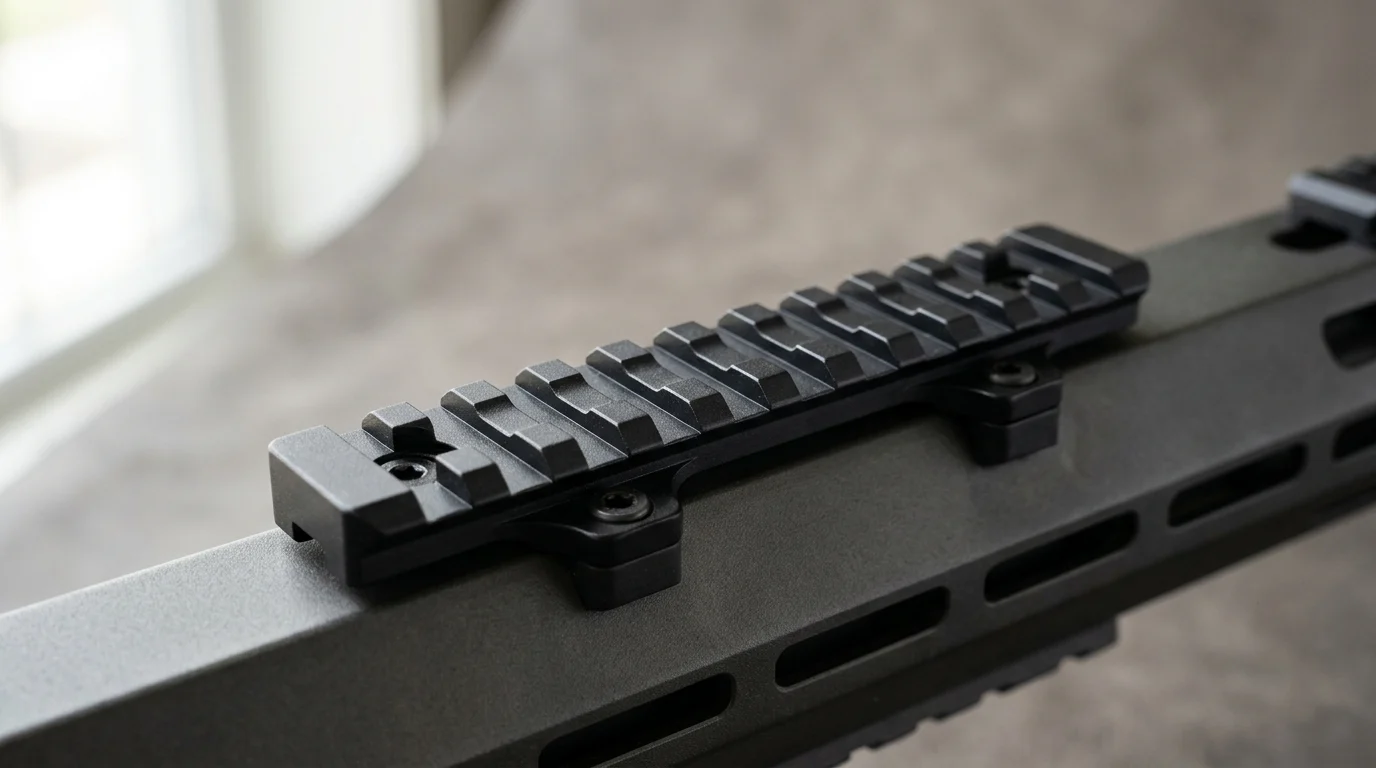
A well-mounted scope can be the difference between a clean shot and a painful half-moon bruise above your eye. For hunters, eye relief is not just a comfort setting; it is a safety and accuracy variable shaped by recoil, stock fit, optic design, and mounting geometry. The Picatinny system gives shooters a standardized grid for making precise scope placement changes without replacing the entire setup. This guide explains how rail dimensions, scope bases, ring height, recoil level, and stock length work together, so you can build a hunting rifle that shoulders naturally, delivers a full sight picture, and keeps your eyebrow out of the danger zone.
Why Picatinny Rail Eye Relief Matters
Nothing ruins a perfectly good hunting trip faster than a bruised eyebrow. The dreaded "scope bite"—that half-moon scar earned by placing an optic too close to the eye on a heavy-recoiling rifle—is a painful rite of passage. Achieving perfect eye relief is the ultimate defense against this, and the modern Picatinny system makes finding that optical sweet spot remarkably easy.
Originally developed for military use, this standard has thoroughly infiltrated the hunting world, replacing older, restrictive Weaver systems. A continuous rail offers a wide range of placement options, ensuring the eye aligns flawlessly with the focal plane every time the rifle is shouldered.
Key rail dimensions that affect scope placement
The utility of the MIL-STD-1913 specification lies in its relentless consistency. Every true scope base rail features slots exactly 0.206 inches wide, with a center-to-center spacing of 0.394 inches. This standardized grid allows for micro-adjusting an optic forward or backward in precise increments.
When a scope needs to move just a fraction of an inch to clear safety glasses or accommodate an unusual shooting stance, these uniform slots provide the exact real estate required without forcing a complete hardware overhaul.
How stock length, recoil, and scope design change eye relief
Eye relief is a delicate balance between the rifle's geometry, the ammunition's recoil, and the optic's internal lenses. A standard rifle scope typically demands 3 to 4 inches of eye relief, though this varies by manufacturer. When firing heavy magnum cartridges, that distance is often stretched to 4.5 inches to avoid facial impact during recoil, which fluctuates depending on the specific load.
Furthermore, a longer length of pull on the rifle's stock naturally pulls the head further back, requiring the scope to be mounted further rearward on the rail to maintain a crisp image without edge distortion.
How to Compare Picatinny Rail Mounting Options
Navigating the sea of mounting hardware requires attention to detail. The ultimate goal is to marry the optic to the rifle securely enough that the assembly withstands freezing rain, accidental drops, and the recoil of ignition.
Choosing the right components means balancing weight, optic height, and forward reach. Shaving ounces off a backcountry rig might point toward 7075-T6 aluminum, while building a heavy magnum rifle might justify the weight penalty of solid steel for absolute rigidity.
What to check before buying a rail or mount
Before purchasing new hardware, baseline requirements must be evaluated. Pushing past the 500-yard mark often calls for a 20 MOA canted base to maximize a turret's elevation travel, while brush applications typically rely on a flat 0 MOA base. Tube diameter is another hard constraint, with 1-inch and 30mm being the most common.
Selecting a high-quality optic mount requires matching these specs perfectly while ensuring the ring height clears the objective lens by at least 0.125 inches to prevent barrel contact.
| Mount Type | Best Application | Typical Forward Offset | Weight Penalty |
|---|---|---|---|
| Standard Vertical | Traditional Bolt-Action | 0.0 inches | Low (3-5 oz) |
| Cantilever | AR-Platform | 2.0 – 3.0 inches | Medium (6-9 oz) |
| Extended Riser | Night Vision / Thermal | Variable | High (8-12 oz) |
When to use a riser, extended base, or offset mount
Sometimes, standard vertical rings cannot position the glass where the eye demands it. Modern sporting rifles with straight-line stocks often force the head too far forward, requiring a specialized cantilever mount to push the optic 2 inches over the barrel nut.
Conversely, running night vision gear or heavy winter masks might require a 0.5-inch to 1.5-inch riser to achieve a comfortable heads-up posture. When standard configurations fail to deliver the necessary clearance, tapping into specialized mounting accessories ensures a natural point of aim without neck strain. However, when using risers, cantilevers, or offset mounts, it is crucial to verify clearance for bolt operation, casing ejection, and barrel harmonics to ensure safe and reliable function.
How to Confirm the Right Setup
Buying top-tier glass and rugged mounts is only half the battle; the true test happens during final assembly. A perfectly dialed-in optic feels like a natural extension of vision, allowing for rapid target acquisition.
Skipping this critical alignment phase often results in squirming behind the stock, wasting precious seconds trying to find a clear sight picture. Confirming this setup requires patience, basic precision tools, and a willingness to mimic actual field conditions before firing a live round.
When repositioning an optic on a Picatinny rail, proper ring alignment is essential to prevent tube stress. Additionally, pushing the mount forward against the recoil lugs before tightening helps guarantee a reliable return-to-zero if the optic is ever removed and reattached.
Step-by-step process for testing eye relief
The gold standard for testing eye relief starts with stabilizing the firearm, preferably using a sturdy rifle bipod or a heavy lead sled. With the rifle secure, close your eyes, shoulder the weapon naturally, and rest your cheek on the stock.
Upon opening your eyes, the sight picture should be instantly clear, with zero black rings (vignetting). If a black shadow creeps in, the optic must slide along the slots. Once the sweet spot is found, it is critical to lock everything down to manufacturer-specific factory specs—though this is often around 15 to 20 in-lbs of torque for ring screws and up to 65 in-lbs for crossbolts, these exact values vary by brand.
Final checks before hunting
The final sanity check happens right before stepping into the wilderness. It is easy to forget that eye relief changes drastically with wardrobe. A thick late-season hunting parka can add up to 1 full inch to the length of pull, effectively pulling the eye away from the optic and ruining the meticulously achieved alignment. The setup must be tested while wearing the intended hunting gear.
Additionally, variable power scopes alter their optical geometry; cranking a scope from 3x
Key Takeaways
- Set most hunting scopes at 3 to 4 inches of eye relief, and increase that distance toward 4.5 inches on heavy-recoiling rifles.
- Use a true MIL-STD-1913 Picatinny rail with 0.206-inch slots and 0.394-inch spacing for repeatable scope positioning.
- Move the optic forward or backward on the rail until you see a full, clear image immediately when shouldering the rifle.
- Choose a 20 MOA canted base for frequent long-range shots beyond about 500 yards, but use a 0 MOA base for typical brush hunting.
- Verify tube diameter and ring height before buying, and keep at least 0.125 inches of clearance above the barrel.
Frequently Asked Questions
What is the ideal eye relief for a hunting scope?
Most hunting scopes need about 3 to 4 inches of eye relief, but heavy-recoiling rifles may require around 4.5 inches to reduce the risk of scope bite.
How does a Picatinny rail help with eye relief?
A Picatinny rail uses standardized slots that let you move the scope forward or backward in small, repeatable increments until the sight picture is clear when shouldered.
What are the key Picatinny slot dimensions?
A true MIL-STD-1913 Picatinny rail has slots 0.206 inches wide with 0.394 inches center-to-center spacing, giving consistent mounting positions across compatible hardware.
Should I choose a 0 MOA or 20 MOA rail for hunting?
Use a 0 MOA rail for typical woods or medium-range hunting, and consider a 20 MOA canted base if you regularly shoot beyond about 500 yards.
How much objective lens clearance do scope rings need?
Choose ring height that leaves at least 0.125 inches of clearance between the objective bell and barrel so the scope does not touch under recoil or field pressure.
Post time: Jul-10-2026