
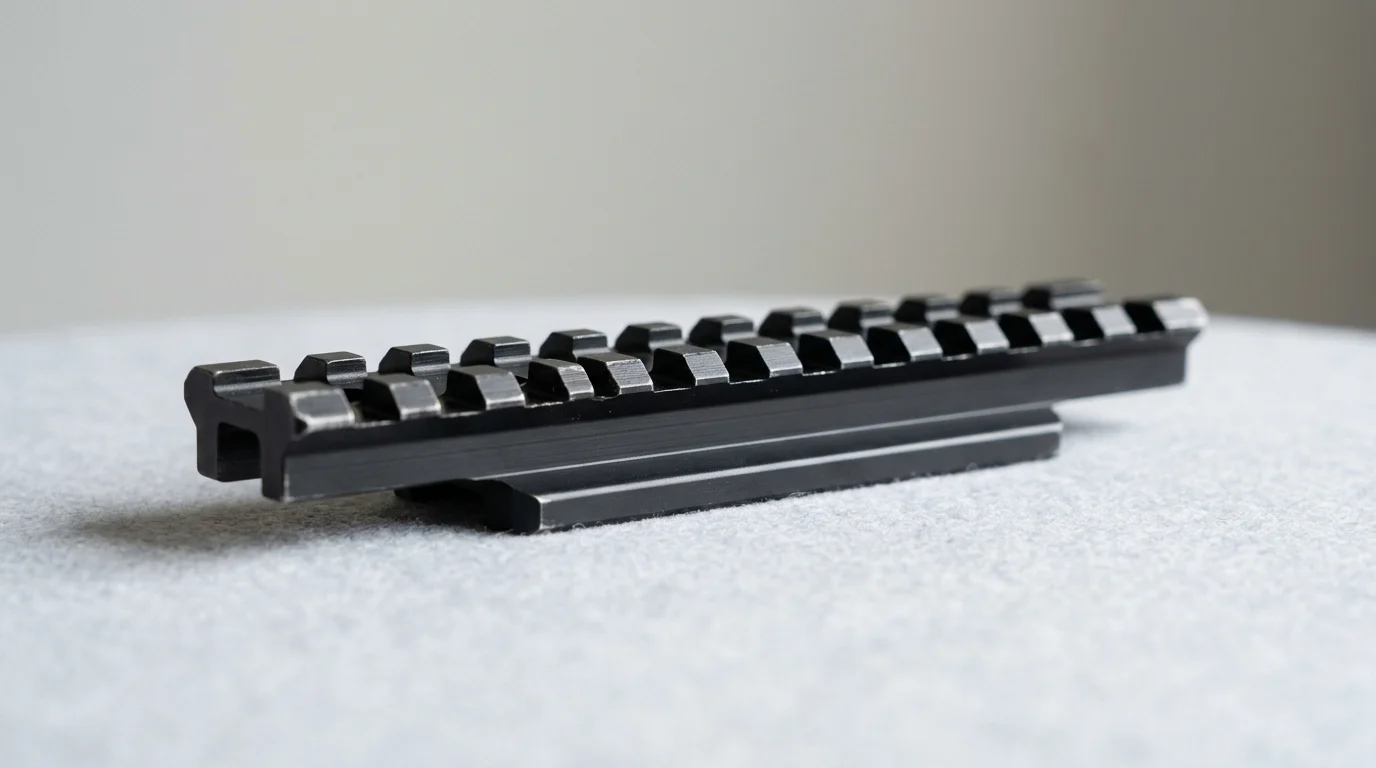
Picatinny Rail Origins and Standardization
Before the modern era of modularity, attaching gear to a tactical platform often required custom gunsmithing and a lot of crossed fingers. The foundation for a standardized solution began with the commercial Weaver rail design, which introduced a basic slot-and-rail concept for optics. However, the transition from iron sights and permanent carry handles to modular flat-top upper receivers required a more universal, rigorously defined interface. Engineers at the Picatinny Arsenal in New Jersey developed a standardized design to meet this military need, creating a highly reliable system for mounting optics and accessories that forever changed how operators customize their setups.
What a Picatinny Rail Is
At its core, the system is a standardized mounting platform consisting of a series of ridges with a T-shaped cross-section, interspersed with flat spacing slots. This ingenious design allows users to slide or clamp gear onto the platform securely, ensuring broad compatibility regardless of the manufacturer.
If you are looking to install a new rail, you are essentially leveraging a bracket system that locks attachments in place using a cross-slot recoil lug. When the firearm recoils, the lug prevents the heavy attached gear from sliding backward under inertia and shifting out of place.
How MIL-STD-1913 Became the Standard
The push for standardized mounting hardware culminated on February 3, 1995, when the U.S. military formally adopted MIL-STD-1913. Researchers at the Picatinny Arsenal took the existing commercial Weaver design, standardized the dimensions with strict tolerances, and provided the military with a universal plug-and-play solution.
Under the MIL-STD-1913 specification, slots measure 0.206 inches (5.23 mm) wide, with center-to-center spacing of 0.394 inches (10.01 mm) and a slot depth of 0.118 inches (3.00 mm), all subject to specific manufacturing tolerances. This dimensional consistency meant that a laser sight issued in California would properly fit a receiver manufactured in Germany. The design’s success eventually led to international standardization efforts, including the draft NATO STANAG 2324 and the later, backward-compatible STANAG 4694 (NATO Accessory Rail), which refined the clamping surfaces for even greater repeatability.
Picatinny vs Weaver, M-LOK, and KeyMod
The firearms industry continually innovates, meaning the original 1913 standard now shares the market with a variety of newer competitors. Understanding the dimensional differences and structural trade-offs is crucial before investing in hardware. While the classic rail revolutionized modularity, the push for lighter, more ergonomic handguards birthed the M-LOK and KeyMod systems, providing users with alternative mounting solutions based on their specific needs.
Key Dimensions, Materials, and Tolerances
The most common point of confusion lies between the classic Weaver system and the modern 1913 standard. While they look similar at a glance, Weaver slots measure approximately 0.180 inches wide, whereas the military standard specifies a 0.206-inch slot. If you try to force a modern mount designed for the 1913 specification onto an older Weaver base, the wider recoil lug simply will not fit into the narrower channel.
Modern rails are built to withstand significant abuse and are commonly machined from aluminum alloys like 6061-T6 or 7075-T6. While 7075-T6 can boast a tensile strength exceeding 74,000 psi depending on the specific alloy composition and temper, materials vary by manufacturer. Steel and polymer are also utilized depending on the application, ensuring the mounting teeth resist shearing under heavy recoil.
Best Uses for a Comparison Table
When evaluating mounting systems for a heavy rifle scope or a sensitive laser aiming module, choosing the right platform comes down to weight, profile, and load-bearing capacity. A comparison table is best used to quickly identify which system aligns with your specific equipment needs. For instance, while M-LOK is highly effective for lightweight flashlight mounts, the 1913 rail remains a primary choice for heavy optics. Here is how these modularity standards stack up against one another:
| Mounting System | Slot Width | Primary Material | Best Use Case | Weight Profile |
|---|---|---|---|---|
| Picatinny (1913) | 0.206 inches | 7075-T6 Aluminum | Heavy optics, lasers | Heavy / Bulky |
| Weaver | 0.180 inches | Aluminum / Steel | Legacy hunting optics | Moderate |
| M-LOK | N/A (Direct attach) | Aluminum / Polymer | Grips, lights, bipods | Ultra-Light |
| KeyMod | N/A (Direct attach) | Aluminum / Polymer | Hand stops, sling mounts | Ultra-Light |
How to Choose and Verify Picatinny Rail Compatibility
Navigating the aftermarket selection of tactical gear requires a keen eye for compatibility. A mismatch between your mounting base and your chosen gear can result in stripped screws, wandering zeros, and frustration at the range. Today’s market includes various hybrid designs, meaning buyers must be informed to avoid costly mistakes and ensure their equipment functions properly when it matters most.
Practical Compatibility Checks
A general rule of backwards compatibility is that Weaver accessories will often fit on a 1913 base, but 1913 gear will rarely fit on a Weaver base. However, this fit is not universal; Weaver mounts placed on a Picatinny rail may sit loose due to the wider slots, while attempting to clamp a 1913 mount onto a Weaver base can damage the rail. When shopping for accessories, always verify the cross-bolt diameter before tightening.
If you are attaching a heavy-duty rifle bipod, ensuring the recoil lug drops cleanly into the 0.206-inch slot without forward-to-back play is essential. Excessive slop can cause the attachment to shift under recoil, potentially damaging the rail’s teeth and affecting precision downrange.
When Picatinny Is Still the Best Choice
Despite the rise of lightweight, direct-attach alternatives, the 1913 standard remains a highly reliable choice for heavy, zero-critical components.
When mounting a primary optic weighing upwards of 30 to 40 ounces, or an infrared laser that must retain its zero under sudden recoil forces, the substantial surface area and rigid, clamp-style lockup of the classic T-shaped rail provide excellent stability.
Key Takeaways
- MIL-STD-1913 was formally adopted on February 3, 1995, turning the Picatinny rail into a universal mounting interface for military accessories.
- A true Picatinny rail uses 0.206-inch-wide slots with 0.394-inch center-to-center spacing, so verify dimensions before buying mounts.
- Do not assume Weaver and Picatinny parts are interchangeable, because a 1913 recoil lug may not fit into a narrower Weaver slot.
- Use Picatinny rails when you need strong recoil resistance, repeatable accessory placement, and broad compatibility across optics, lights, and lasers.
- Consider M-LOK or KeyMod for lighter handguard setups, but keep Picatinny sections where accessories require a 1913-style clamp.
Frequently Asked Questions
What is a Picatinny rail?
A Picatinny rail is a standardized accessory mounting platform with T-shaped ridges and evenly spaced cross-slots. It lets users securely attach optics, lights, lasers, grips, and other compatible gear.
When did the Picatinny rail become a military standard?
The U.S. military adopted the Picatinny rail as MIL-STD-1913 on February 3, 1995, after engineers at Picatinny Arsenal standardized the earlier Weaver-style rail concept.
How is Picatinny different from Weaver?
Picatinny and Weaver rails look similar, but Picatinny slots are standardized at 0.206 inches wide, while Weaver slots are typically about 0.180 inches. Some Picatinny mounts may not fit older Weaver bases.
Why does slot spacing matter on a Picatinny rail?
Consistent slot spacing helps accessories mount securely and repeatably. MIL-STD-1913 specifies 0.394-inch center-to-center spacing, improving compatibility across manufacturers and platforms.
Can M-LOK or KeyMod replace a Picatinny rail?
M-LOK and KeyMod are lighter, lower-profile systems often used on handguards, but Picatinny remains widely used for optics and accessories that require broad compatibility and strong recoil resistance.
Post time: Jul-09-2026