
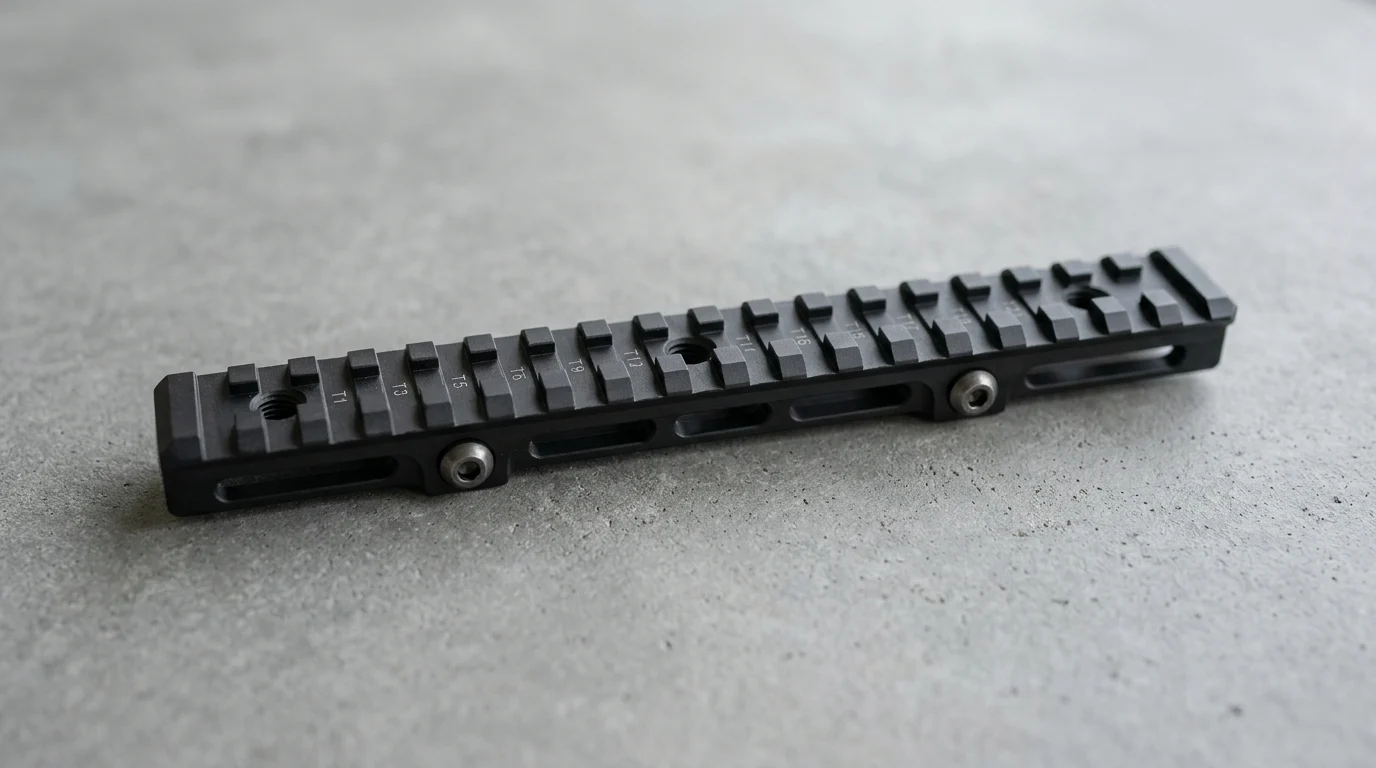
Why the Picatinny Rail Still Guides Accessory Strategy
Amid the relentless evolution of sporting and tactical firearms, the MIL-STD-1913 platform remains a constant. Looking ahead to 2026, the Picatinny rail continues to serve as a reliable foundation for accessory strategies. While lighter, lower-profile alternatives like M-LOK and KeyMod have become popular for handguards, Picatinny remains the undisputed standard for [receiver-mounted optics](https:// www.chenxioutdoor.com/sporting-type-scope/) and heavy-duty accessories due to its unmatched shear strength. This rail system ensures that heavy optics, lights, and grips lock down securely without shifting under stress.
What a Picatinny Rail Defines
At its core, this platform relies on standardized dimensions that provide universal compatibility. With a recoil groove width of exactly 0.206 inches (5.23 mm) and a center-to-center groove spacing of 0.394 inches (10.01 mm), it ensures that gear locks down securely. It is important to clarify the compatibility between Picatinny and older Weaver systems: while Weaver accessories will generally fit on a Picatinny rail, Picatinny-specific accessories often will not fit older Weaver rails due to the Weaver’s narrower slots and inconsistent spacing.
Whether mounting a heavy-duty scope base or rail extension for complex setups or a precision optic for long-range engagements, these exacting tolerances help prevent movement under heavy recoil. Proper lockup—utilizing integrated recoil lugs and adhering to manufacturer-specific torque specifications—ensures equipment performs reliably and maintains zero. Readers should always consult current manuals for exact torque values, as these vary widely by brand and material.
Key Market Shifts Affecting Accessory Choices
Approaching 2026, specific market trends are reshaping how platforms are equipped. Manufacturers are increasingly utilizing advanced polymers and skeletonized 7075-T6 alloys to offset the inherent bulk of Picatinny systems. Industry estimates suggest these materials can reduce component weight by up to 30% without sacrificing structural integrity, though actual reductions vary by supplier and design.
Additionally, 2026 is seeing a surge in smart accessories, such as miniaturized laser rangefinders, environmental sensors, and emerging power-delivery rails that route battery power directly through the rail to mounted devices. These developments streamline cable management and enhance situational awareness, allowing users to optimize their setups for modern operational requirements.
How to Compare Picatinny Rail Accessories

Comparing options requires a clear understanding of how each component interacts to elevate performance. Evaluating gear against strict quality standards is crucial, as out-of-spec or counterfeit rails and mounts can cause severe zero shift or even damage to expensive optics.
Specs to Compare for Optics, Lights, and Grips
When evaluating a loadout, specifications must align with the intended application. For instance, selecting a rifle scope for mid-range engagements often points toward Low Power Variable Optics (LPVOs) with 1-6x or 1-8x magnification, whereas red dot sights are better suited for close-quarters speed.
Tactical lights are judged on both candela and raw luminous flux; modern estimates for primary defensive rifle setups often target around 1,000 lumens and 50,000 candela to punch through photonic barriers, whereas pistol lights typically prioritize wider flood over high candela. Grips also vary significantly: vertical grips offer robust control for heavy platforms, while angled grips (often featuring a 15 to 20-degree angle) can reduce wrist fatigue during extended use.
| Accessory Type | Key Specification | Estimated Target Benchmark* | Example Use Case |
|---|---|---|---|
| Optics | Magnification / Tube Size | 1-8x LPVO / 30mm – 34mm | Mid-Range Precision |
| Lights | Luminous Flux / Candela | ~1,000 Lumens / ~50,000 Candela | Defensive / Low-Light |
| Grips | Grip Angle / Material | 15°-20° / High-Impact Polymer | Extended Patrol / Recoil Mitigation |
*Note: These benchmarks are general-purpose suggestions, not universal requirements. Always tailor specifications to your specific operational needs and manufacturer guidelines.
Weight, Durability, and Compatibility Factors
Beyond individual specifications, the synergy of weight, durability, and compatibility dictates success in the field. Accessories machined from 7075-T6 aerospace-grade aluminum offer a remarkable tensile strength of over 74,000 psi while keeping the overall footprint relatively light.
For example, adding a precision rifle bipod to the forward rail can drastically improve [long-range stability](https:// www.chenxioutdoor.com/bipod/), but front-end weight must be carefully managed. Keeping forward-mounted accessories as light as possible helps maintain rapid transitional agility and balance. Furthermore, ensuring that heavy accessories feature robust crossbolts or recoil lugs is vital to prevent shearing under sustained fire.
How to Choose the Right Picatinny Rail Setup
Taking a configuration from concept to a fully realized setup requires navigating the practical realities of sourcing, compliance, and logical assembly.
Sourcing, Compliance, and Logistics Considerations
Whether you are a consumer building a bespoke platform or a commercial buyer managing retail inventories, sourcing goes beyond simply picking a brand from a catalog. Buyers must be aware of international trade compliance, as [advanced optics](https:// www.chenxioutdoor.com/sporting-type-scope/) and thermal devices may be subject to strict export controls depending on the jurisdiction. Always consult local legal counsel regarding import/export regulations, as rules vary significantly by country and product type.
When dealing with international manufacturers for bulk orders, commercial buyers should anticipate Minimum Order Quantities (MOQs) and lead times. These figures are highly manufacturer-specific and can range from dozens to hundreds of units, with wait times spanning weeks to months. Buyers must communicate directly with suppliers for current, accurate logistics data to ensure critical inventory remains stocked or personal builds stay on schedule.
A Practical Configuration Decision Path
With logistics securely handled, the focus shifts to the configuration decision path. A logical workflow generally starts from the receiver and moves forward:
- Primary Optic: Secure the primary optic on the upper receiver to ensure proper eye relief. Apply the manufacturer’s specific torque recommendations (while 15-25 in-lbs for rings and 30-65 in-lbs for bases are common benchmarks, these are not universal—always verify with your specific mount’s manual) to prevent zero shift.
- Illumination: Position illumination devices where they can be easily activated without shifting the primary grip, often utilizing offset mounts to save top-rail space.
- Control Accessories: Place vertical or angled grips on the bottom rail to optimize ergonomics and recoil management.
Key Takeaways
- Use Picatinny for receiver-mounted optics and heavy accessories when recoil resistance and secure lockup matter more than minimum weight.
- Verify true MIL-STD-1913 dimensions, including 0.206-inch groove width and 0.394-inch groove spacing, before trusting a rail or mount.
- Do not assume full Weaver compatibility, because Weaver accessories often fit Picatinny rails but Picatinny accessories may not fit older Weaver rails.
- Match optics to use case by choosing LPVOs such as 1-6x or 1-8x for mid-range work and red dots for close-range speed.
- Evaluate rifle lights by both lumens and candela, with many modern defensive setups aiming near 1,000 lumens and 50,000 candela.
- Follow manufacturer torque specifications and ensure recoil lugs are properly seated to reduce zero shift and protect expensive optics.
Frequently Asked Questions
Why is the Picatinny rail still important in 2026?
Picatinny remains the preferred standard for receiver-mounted optics and heavy accessories because its standardized slots and strong lockup resist shifting under recoil better than many lighter mounting systems.
What are the standard Picatinny rail slot dimensions?
A Picatinny rail uses a 0.206-inch recoil groove width and 0.394-inch center-to-center groove spacing, helping optics, lights, and grips mount consistently across compatible platforms.
Will Weaver accessories fit on a Picatinny rail?
Weaver accessories generally fit Picatinny rails, but Picatinny-specific accessories may not fit older Weaver rails because Weaver slots are often narrower and less consistently spaced.
What optics work well on a Picatinny rail?
LPVOs such as 1-6x or 1-8x scopes suit mid-range use, while red dot sights are better for close-range speed. Proper torque and recoil-lug engagement help maintain zero.
How bright should a rifle-mounted light be?
Many modern defensive rifle setups target about 1,000 lumens and 50,000 candela, balancing overall brightness with enough beam intensity to push through photonic barriers.
Post time: Jul-09-2026