
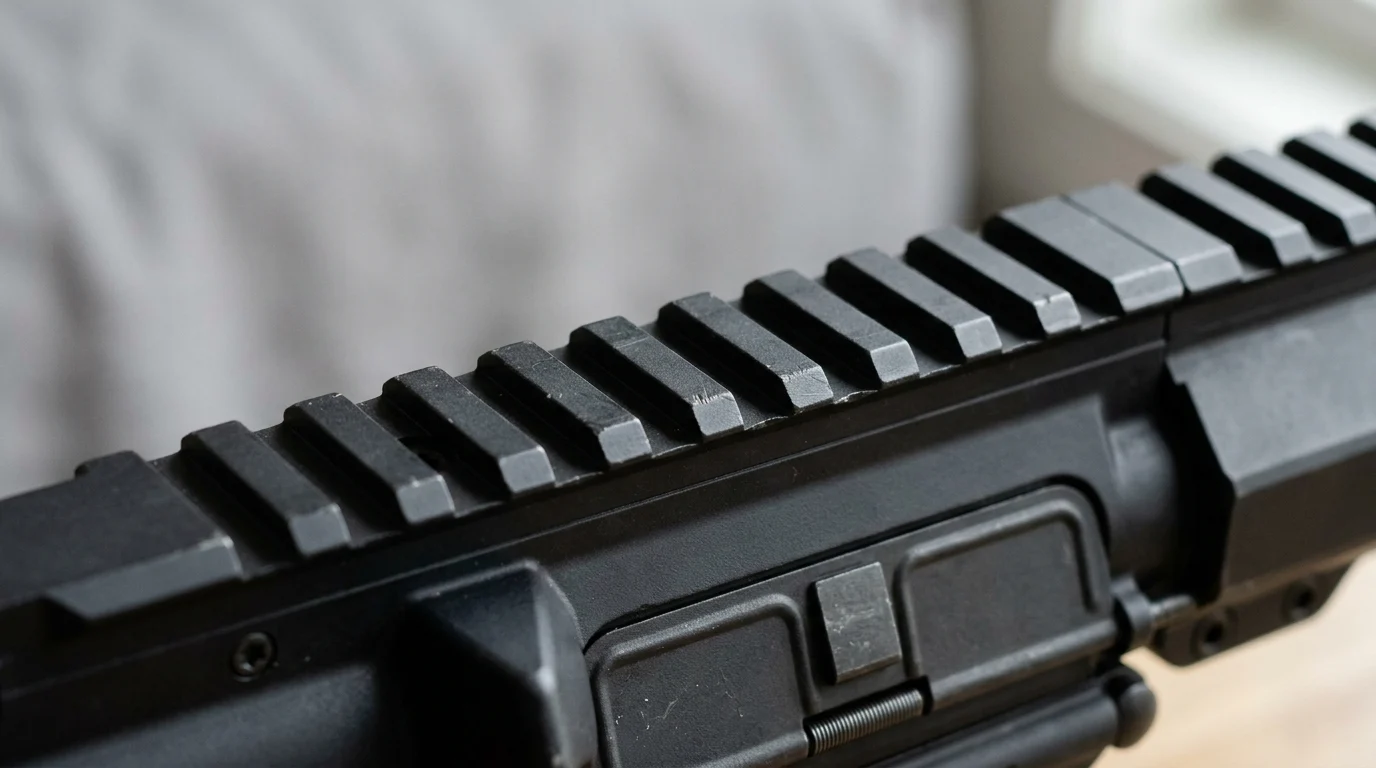
A rail may look like a simple strip of metal, but its dimensions determine whether an optic holds zero, a bipod locks up solidly, or a light survives recoil. The Picatinny interface became the dominant mounting system because MIL-STD-1913 turned accessory attachment into a predictable, repeatable standard rather than a custom-fitting problem. This guide explains the measurements that matter, including slot width, depth, and spacing, and shows why those numbers affect real-world fitment. It also clarifies the practical differences between Picatinny, Weaver, and NATO-style systems so buyers, builders, and shooters can avoid compatibility mistakes when selecting mounts, rings, scope bases, and other rail-mounted hardware.
Why the Picatinny Rail Remains the Standard
The military's official adoption of MIL-STD-1913 transformed the firearms industry by providing a single, unified interface for mounting hardware. Today, whether attaching a flashlight, a laser designator, or a precision rifle bipod, this standard ensures consistent fitment across diverse platforms.
The utility of the design lies in its simplicity, ruggedness, and widespread integration. While MIL-STD-1913 practically eliminated the need for custom gunsmithing and specialized adapter plates, users still rely on standard commercial mounts, rings, and clamping surfaces to attach accessories securely to the rail. However, it is important to note that many commercial products labeled "Picatinny" are not formally certified to MIL-STD-1913 and may be manufactured with looser tolerances.
What MIL-STD-1913 Defines
The effectiveness of MIL-STD-1913 stems from its strict dimensional requirements outlined in the official technical drawing. To guarantee universal fitment, the standard dictates a nominal transverse slot width of 0.206 inches (5.23 mm) and a continuous center-to-center slot spacing of 0.394 inches (10.01 mm), both subject to specified manufacturing tolerances.
Furthermore, the nominal slot depth measures 0.118 inches (3.00 mm). These standardized dimensions mean a piece of gear manufactured in one region will seamlessly clamp onto a receiver built in another. Because the spacing is consistent across the entire length of the platform, users can slide their optics forward or backward to achieve proper eye relief while maintaining engagement with the recoil lugs.
Why Picatinny Became the Common Mounting System
Before this universal system was adopted, mounting a rifle scope or other optics often required proprietary brackets, forcing armorers to custom-drill and tap receivers. Navigating various mismatched rings and bases was a logistical challenge.
To solve this, engineers at the Picatinny Arsenal in New Jersey evaluated existing commercial designs and established a uniform profile for scope bases designed to withstand rigorous field conditions. By standardizing the recoil groove dimensions and the angular profile, manufacturers could produce cross-compatible gear. This reduction in proprietary mounting footprints simplified military supply chains and established the 1913 specification as a foundational baseline for modern firearms accessories.
Picatinny vs Weaver and NATO STANAG
While the 1913 standard is highly prevalent, it shares mechanical characteristics with the older commercial Weaver design and has since inspired the modernized NATO STANAG 4694 specification.
Understanding the dimensional and geometric nuances between these three systems is crucial for preventing compatibility errors during manufacturing or assembly.
Key Differences in Dimensions, Slot Spacing, and Recoil Lugs
A common point of confusion involves Weaver and Picatinny dimensions. A standard Weaver slot measures roughly 0.180 inches wide, which is narrower than the 0.206-inch 1913 slot. Because of this discrepancy, an accessory with a full-width MIL-STD-1913 recoil lug will not fit into a Weaver slot. Conversely, Weaver accessories will often fit into a 1913 system, though this loose front-to-back play can cause optics to shift under recoil. Users should always verify proper recoil-lug engagement rather than assuming universal compatibility. Additionally, Weaver slot spacing is highly variable, meaning not all Weaver accessories are interchangeable even on Weaver rails.
Meanwhile, the NATO STANAG 4694 standard is a metric-based system that maintains a similar dimensional footprint to the 1913 spec but refines the clamping geometry. Rather than relying solely on the bottom angles, STANAG 4694 utilizes the top surface of the rail for primary alignment alongside tighter tolerances, improving return-to-zero reliability. Regarding backward compatibility: most MIL-STD-1913 accessories will fit STANAG 4694 rails, but the reverse is not guaranteed. Newer STANAG-optimized clamps may not seat correctly on older 1913 rails because the required top-reference geometry is not always present.
When to Use a Comparison Table
To prevent tolerance stacking and determine which standard suits a specific application, industry professionals rely on comparison matrices. Weaver is typically reserved for legacy sporting arms, MIL-STD-1913 serves as the baseline for general tactical and commercial use, and STANAG 4694 is chosen for modern military applications requiring strict return-to-zero tolerances.
| Standard | Slot Width | Slot Spacing | Primary Alignment Surface |
|---|---|---|---|
| Weaver | 0.180 in (4.57 mm) | Variable | Bottom Angles |
| MIL-STD-1913 | 0.206 in (5.23 mm) | 0.394 in (10.01 mm) | Bottom Angles |
| NATO STANAG 4694 | 0.206 in (5.23 mm) | 0.394 in (10.01 mm) | Top Surface & Bottom Angles |
How to Specify, Source, and Inspect Picatinny Rails
Procuring a reliable mount requires adherence to strict machining tolerances. A mounting platform relies heavily on consistent cutting tools and quality control processes.
For instance, the V-angles on the sides of the profile are specified at 45 degrees relative to the perpendicular (creating a 90-degree included angle). Rather than relying on generalized assumptions, exact angular and dimensional tolerances must be strictly verified against the official MIL-STD-1913 Technical Data Package (TDP). Deviation here can cause the clamping mechanism to bite incorrectly or fail to secure the load. Furthermore, tolerance stack-up in real-world use means that both the rail and the accessory must remain strictly within spec for reliable clamping and return-to-zero.
Practical Inspection Steps for MIL-STD-1913 Fit
When inspecting a newly machined batch of rails, quality assurance requires traceable go/no-go gauges to verify the nominal 0.206-inch slot width and the continuous 0.394-inch spacing. Inspectors often rely on Coordinate Measuring Machines (CMM) and defined sampling plans to ensure the 45-degree angles remain parallel down the entire length of the extrusion.
Furthermore, machinists must account for surface treatments before applying the final finish. While a standard Type III hard-coat anodizing is frequently cited as adding roughly 0.002 inches of total thickness, this is merely a rule of thumb. It is crucial to remember that this coating both penetrates the aluminum and builds up on the surface, and penetration-to-build-up ratios vary significantly by specific alloy and anodizing process. If the raw 6061-T6 or 7075-T6 aluminum is not machined with these pre-coating allowances in mind, the final product may fail inspection. Consequently, final dimensions must always be verified with calibrated gauges after finishing to prevent fitment issues for the end-user.
Key Takeaways
- Use true MIL-STD-1913 dimensions when compatibility matters, especially the 0.206-inch slot width and 0.394-inch center-to-center slot spacing.
- Verify recoil-lug engagement before firing, because Weaver accessories may fit on Picatinny rails but can shift under recoil if the fit is loose.
- Do not assume every product labeled Picatinny is formally MIL-STD-1913 compliant, since many commercial rails and mounts use looser tolerances.
- Choose Picatinny-compatible scope bases, rings, and mounts to reduce the need for custom drilling, tapping, or proprietary adapter plates.
- Adjust optics along the rail to achieve proper eye relief while keeping the mount seated securely in the standardized recoil slots.
Frequently Asked Questions
What does MIL-STD-1913 define for a Picatinny rail?
MIL-STD-1913 defines the rail’s critical geometry, including slot width, slot depth, center-to-center spacing, and profile requirements so mounts, optics, bipods, lights, and other accessories can fit consistently across compatible platforms.
What is the standard Picatinny slot width?
The nominal transverse slot width for MIL-STD-1913 is 0.206 inches, or 5.23 mm. This width is a key reason true Picatinny-compatible accessories can engage securely with the rail.
How is Picatinny different from Weaver?
Picatinny slots are typically 0.206 inches wide, while Weaver slots are roughly 0.180 inches. A Picatinny recoil lug may not fit a Weaver slot, while Weaver accessories may fit Picatinny rails but can have unwanted movement under recoil.
Can all accessories labeled Picatinny be trusted to meet MIL-STD-1913?
Not always. Many commercial products use the Picatinny name but are not formally certified to MIL-STD-1913, so tolerances may vary. Always check fit, recoil-lug engagement, and manufacturer specifications.
Why did the Picatinny rail become so widely used?
It replaced many proprietary mounting systems with a common interface, reducing custom gunsmithing and simplifying accessory compatibility for scopes, mounts, rings, bipods, lights, and lasers.
Post time: Jul-09-2026