
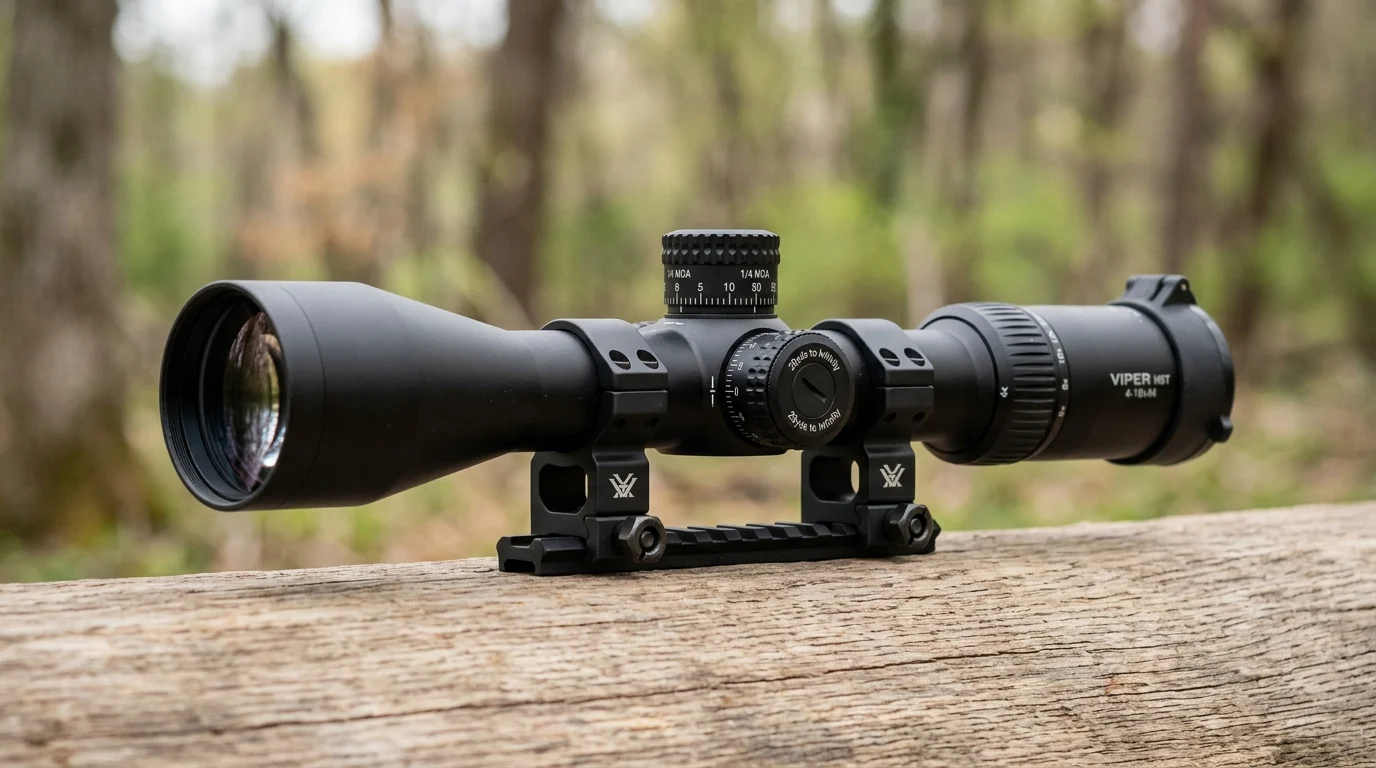
Modern hunters are rethinking the default choice of a magnified rifle scope, especially when the terrain is tight, the target window is short, and speed matters more than zoom. Red dot and holographic sights offer a faster, more open aiming experience by letting shooters keep both eyes on the animal and the surrounding cover. But they are not interchangeable, and they are not ideal for every hunt. This guide breaks down how the two technologies differ, where non-magnified optics shine, and when a traditional scope, LPVO, or prism sight is still the smarter tool for ethical, confident shot placement.
Why Red Dot and Holographic Sights Work for Hunting
For generations, hunters have relied on the traditional magnified rifle scope to reach out and touch targets at a distance. However, modern hunting often demands something faster, lighter, and more forgiving. While low-power variable optics (LPVOs), fixed-power scout scopes, and prism sights offer excellent middle-ground alternatives, the non-magnified reflex optic has truly revolutionized close-range engagements. Originally popularized in tactical and competitive shooting circles, red dots and holographic sights have entered the hunting woods, offering a distinct advantage when split-second reactions matter more than extreme magnification.
Ditching the traditional crosshairs for an illuminated reticle allows shooters to keep both eyes open, preserving peripheral vision and situational awareness. Whether tracking a fast-moving target in thick brush or setting up for a sudden close-range encounter, understanding the shift toward these high-tech glass alternatives is a practical step toward modernizing a hunting rig.
Red Dot vs. Holographic Sights: Key Differences
While they look similar to the uninitiated, red dots and holographic sights rely on entirely different technologies. A standard red dot sight uses a simple LED emitter to bounce light off a curved, coated piece of glass back into the shooter’s eye. This straightforward design is incredibly energy-efficient and lightweight, often featuring "always-on" or shake-awake technology.
Holographic sights, on the other hand, use a complex laser diode to project a three-dimensional hologram of a reticle onto the viewing window, making it appear to float out in front of the weapon. It is important to clarify that true holographic sights (principally manufactured by EOTech) represent a tiny niche in the hunting world. Because of their power-hungry lasers—which require manual powering on and off—as well as their added bulk and premium price tags, most hunters seeking versatility are actually choosing between budget-friendly red dots, prism scopes, and LPVOs. Red dots dominate general field applications, leaving holographics as a highly specialized choice.
Best Hunting Scenarios for Fast Target Acquisition
The greatest advantage of non-magnified optics is the sheer speed of target acquisition. When a hunter shoulders the weapon, the dot is simply there—no squinting, no worrying about perfect eye relief, and no scope shadow blocking the view.
These sights thrive in environments where shots are taken well under the 150-yard mark. Dense pine thickets, swampy bottomlands, and heavily wooded ridges are the natural habitats for these optics. In these tight quarters, a hunter might only have two seconds to identify a target, shoulder the weapon, and fire before the animal vanishes into the brush. Keeping both eyes open allows the brain to superimpose the glowing reticle over the target naturally, making it a highly effective tool for fast-paced, close-quarters hunting.
However, these optics are not universally superior. To make the best decision for your hunt, consider these limitations and know when to skip them:
Low-Light and Long-Range Inadequacy: Electronic sights cannot match the light-gathering capabilities of a large objective lens on a traditional scope at dawn or dusk. Furthermore, hunters should skip non-magnified optics for open-country hunting where magnification is necessary for ethical shot placement and target identification. In these scenarios, an LPVO or traditional scope is required.
Parallax Error: While often marketed as completely parallax-free, this is a misconception. Slight reticle shifts can and do occur at odd shooting angles or from unconventional field positions, which can turn a near-miss into a wounded animal if the shooter's head is not properly aligned.
Cold-Weather and Battery Failures: Extreme cold severely degrades battery performance, which can lead to unexpected power loss in the field. Budget-tier optics are especially vulnerable to rapid battery drain in freezing temperatures, making premium models a safer bet for winter hunts.
Electronic-Sight Regulations: Always check regional regulations before heading into the field. Some jurisdictions strictly prohibit or restrict the use of electronic, battery-powered sights during specific hunting seasons, such as muzzleloader or primitive weapons seasons. A single-line warning in a rulebook can result in hefty fines if overlooked.
Red Dot vs. Holographic Sights: Speed, Accuracy, and Field Use
Deciding between a red dot and a holographic sight comes down to balancing speed, precision, and the physical realities of the hunt. Both excel in close-range environments, but their distinct features offer different advantages depending on the game being pursued and the conditions of the field.
Comparison Table for Hunters
To help hunters weigh their options, the table below breaks down the core metrics that dictate field performance. Holographic sights generally offer a more complex reticle that aids in rapid centering, while red dots win out on weight and long-term operating costs.
| Feature | Red Dot Sights | Holographic Sights |
|---|---|---|
| Reticle Size | Typically 2 to 6 MOA dot | Varies (e.g., 1 MOA dot with 65 MOA ring common on EOTech) |
| Battery Life | 30,000 to 50,000+ hours (premium models) | 500 to 1,000 hours |
| Average Weight | 4 to 7 ounces | 10 to 14 ounces |
| Weather Sealing | High (often IPX7 or better) | Extremely High (typically submersible) |
| Emitter Durability | Excellent (fewer moving parts) | Excellent (functions even with shattered front glass) |
| Astigmatism Friendly | Poor to Fair (dot may starburst) | Varies by individual (often appears crisper) |
Hunters should also consider the ecosystem of accessories available, such as flip-to-side magnifiers, which can instantly stretch the capability of either optic out to 200 yards when necessary.
Field Examples: Whitetail, Hog, and Turkey Hunting
In the real world, these optics shine in very specific scenarios. Imagine hunting whitetail deer in the thick timber of the Northeast. A buck jumps from a bedding area and bounds through the trees. A 2 MOA red dot allows the hunter to swing the rifle smoothly, track the shoulder, and place a clean shot without getting lost in a magnified tube.
Feral hog hunting presents an even more chaotic environment.
How to Choose, Mount, Zero, and Maintain Your Sight
Swapping a traditional hunting scope for a red dot or holographic sight means adapting to new setup routines. A brilliant optic is absolutely useless if it rattles loose after three shots or its battery dies in the freezing rain.
Mounting and Zeroing Steps
Securing an optic requires more than brute strength and a rusty Allen wrench. According to the National Shooting Sports Foundation (NSSF), improperly torqued mounts are a leading cause of wandering zeroes in the field.
- Torque to spec: Use a specialized firearm torque driver. Most optic mounts require 15 to 25 inch-pounds of force. Over-tightening can crush internal components, while under-tightening practically guarantees the sight will shift under heavy recoil.
- Bore sight first: Save expensive ammunition by aligning the optic’s reticle with a laser bore sighter before heading to the live range.
- Confirm with live fire: Unlike a high-powered hunting scope typically zeroed at 100 or 200 yards, many hunters zero unmagnified electronic sights at 50 yards. Fire three-round groups from a stable rest, adjusting the windage and elevation turrets until the point-of-aim perfectly matches the point-of-impact.
Battery, Durability, and Maintenance Tips
Electronic sights demand a different maintenance mindset compared to a traditional glass hunting scope. Keeping them field-ready comes down to power management and basic care.
- Battery Management: LED red dots are famous for sipping power, often boasting up to 50,000 hours of continuous use on a single CR2032 battery. Holographic sights, however, rely on power-hungry lasers that typically max out around 1,000 hours. Always pack spare lithium batteries in your gear, as freezing hunting conditions will drain power reserves significantly faster.
- Lens Care: Treat the glass with respect. Use a clean microfiber cloth and a dedicated lens pen. Scrubbing dried mud off the glass with a rough hunting jacket will permanently scratch the delicate anti-reflective coatings.
- Durability Checks: After a rugged trip through the brush, inspect the battery cap’s rubber O-ring to ensure it remains waterproof, and verify that the mounting bolts have not vibrated loose.
Key Takeaways
- Choose a red dot for fast close-range hunting where most shots are inside about 150 yards.
- Keep both eyes open with a non-magnified optic to improve peripheral vision and speed in dense cover.
- Pick a red dot over a holographic sight if battery life, lighter weight, and lower cost are top priorities.
- Use a traditional magnified scope or LPVO when you need better target identification, low-light performance, or longer-range precision.
- Consider holographic sights only for specialized use, since their laser systems add bulk, cost, and higher power demand.
Frequently Asked Questions
Are red dot sights good for hunting?
Yes, red dots work well for close-range hunting in thick brush, timber, and fast-shot scenarios, especially inside about 150 yards where speed and both-eyes-open aiming matter more than magnification.
What is the main difference between a red dot and a holographic sight?
A red dot uses an LED reflected off coated glass, while a holographic sight uses a laser to project a reticle image. Red dots are usually lighter, simpler, cheaper, and more battery-efficient.
Which sight is better for battery life?
Red dots usually win on battery life because LED emitters use far less power than holographic laser systems. Many red dots also offer shake-awake or always-on settings for field convenience.
Can a red dot replace a traditional hunting scope?
Only in certain hunts. A red dot can replace a scope for close shots and fast target acquisition, but a magnified scope is better for long-range shooting, precise aiming, and low-light performance.
Are holographic sights worth it for hunters?
For most hunters, holographic sights are a niche choice because they are bulkier, more expensive, and more power-hungry. They can be useful, but red dots are usually more practical for general hunting.
Post time: Jul-31-2026