
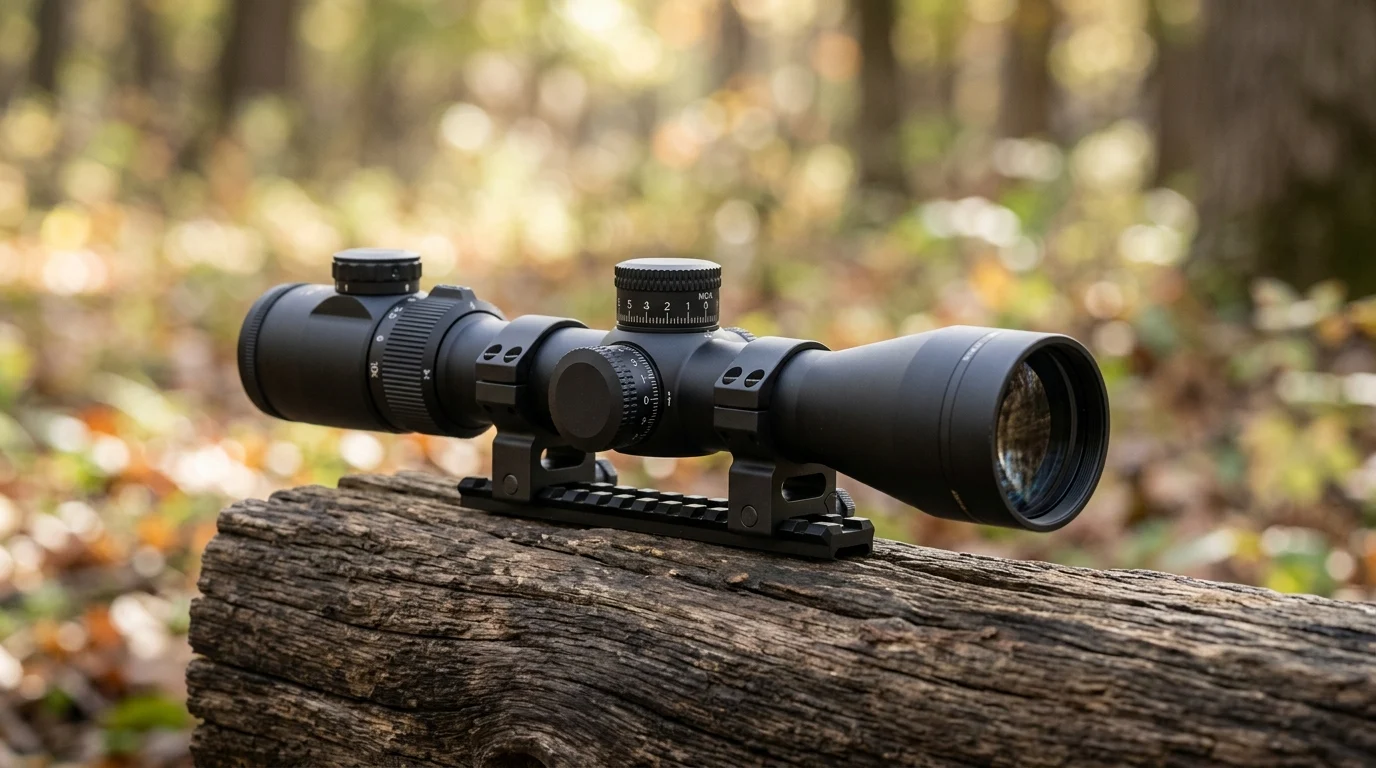
A close-range shot in thick timber rarely gives a hunter time to adjust, search for eye relief, or dial magnification. At 25 to 50 yards, the better optic is usually the one that helps you find the animal fastest while keeping awareness of brush, movement, and backstop. This guide compares red dot sights and low-power prism optics for short-distance hunting, focusing on speed, reticle clarity, astigmatism, weather resistance, and practical field trade-offs. The right choice depends less on marketing claims and more on how your eyes, rifle, terrain, and typical shot distance interact when seconds matter.
Start with Red Dots for Close-Range Hunting
Close-range hunting requires quick reflexes and situational awareness. When a wild boar or a whitetail deer appears in thick brush at 25 to 50 yards, hunters often do not have time to find the perfect eye box on a high-magnification optic. This dynamic environment demands speed, making unmagnified red dots and prism scopes popular choices for the timber. Whether wielding a classic lever-action brush gun or a modern sporting rifle, selecting the right optic dictates how efficiently a hunter can acquire a target during a sudden encounter.
How Red Dot Sights Work
Red dot sights operate on a straightforward premise: an energy-efficient LED emitter (often drawing less than 2 microamps) projects a beam of light onto a specially coated piece of curved objective glass, bouncing that light straight back into the shooter's eye. Because this reflex system is largely parallax-free at typical hunting distances, hunters can keep both eyes wide open, maintaining their peripheral vision. A standard 2 MOA (Minute of Angle) dot covers roughly two inches of the target at 100 yards, providing precision without cluttering the view. For hunters tracking moving game through dense thickets, this minimalist approach ensures rapid target acquisition. However, red dots do have vulnerabilities: operating reliably between -20°F and 140°F, the exposed emitter on open-style sights can still be obstructed by mud, snow, or frost, and the projected reticle may occasionally wash out against extremely bright backgrounds.
When Prism Scopes Help with Astigmatism
Standard red dots can also be problematic for the roughly 30% of the population diagnosed with astigmatism. Due to an irregularly shaped cornea, astigmatic eyes cannot properly focus the projected LED light. Instead of seeing a crisp crimson dot, these hunters might see a smeared starburst, a comet tail, or a cluster. This is where prism scopes offer a practical alternative. Instead of projecting an LED onto a lens, these optics use a solid glass prism to focus the image (typically offering 85% to 90% light transmission) and feature a physically etched reticle. Combined with an adjustable diopter ring that typically swings from -2 to +2, prism scopes deliver a sharp aiming point regardless of corneal imperfections. Furthermore, these etched reticles often include advanced features like Bullet Drop Compensator (BDC) holdovers that standard red dots typically lack. Hunters should note, however, that etched prism reticles can sometimes appear overly thick and obscure small targets, and their illumination is often dimmer or more prone to bloom than a red-dot emitter in low light.
Compare Key Hunting Scope Specifications
Selecting a reliable hunting optic for close-quarters use requires evaluating several critical specifications to ensure the sight performs flawlessly in harsh weather and dynamic environments. Cost is also a primary decision factor; while basic red dots are often highly affordable, premium prism scopes typically require a larger budget, reflecting their complex internal glass and etched reticles.
| Specification | Red Dot Sights | Prism Scopes (1x – 3x) |
|---|---|---|
| Typical Weight | 3 to 6 ounces | 9 to 18 ounces |
| Eye Relief | Unlimited | Fixed (2.5 to 3.5 inches) |
| Battery Life | 20,000 to 50,000+ hours | 500 to 3,000 hours |
| Reticle Type | Projected LED | Physically Etched Glass |
| Typical Cost | $100 to $400+ | $250 to $600+ |
Magnification, Weight, and Field of View
Magnification and weight are key considerations when outfitting a hunting rifle. Traditional red dots are lightweight (typically 3 to 6 ounces) and offer true 1x magnification with unlimited eye relief. While the optic's housing still physically limits the visible scene through the window, unlimited eye relief allows hunters to position their head at any distance behind the sight without losing the dot. Prism scopes, containing internal glass blocks, are noticeably heavier, often weighing between 9 and 18 ounces.
Furthermore, prism optics have a fixed eye relief (the required distance from the ocular lens to the eye, usually 2.5 to 3.5 inches) and a tighter eye box (the positional forgiveness behind the optic). Even 1x prism scopes impose this fixed eye relief, making them less forgiving and slower for snap-shooting from unconventional or dynamic positions in heavy brush. Additionally, this shorter, fixed eye relief can be a safety and comfort liability on heavy-recoil rifles, increasing the risk of scope bite. While a 3x prism scope offers a magnified field of view (typically 30 to 35 feet at 100 yards), the exact width depends heavily on the specific model's optical design. It does, however, require hunters to be slightly more deliberate with their cheek weld when tracking moving game compared to a 1x red dot.
Battery Life, Durability, and Mounting Options
When it comes to electronic endurance, red dots are highly efficient. A quality red dot can boast 20,000 to 50,000 hours of continuous battery life on a single CR2032 cell, though runtimes vary dramatically based on the specific model and brightness setting, and many modern models extend this via motion-activation technology. Prism scopes consume battery power faster when illuminated (often draining a battery in 500 to 3,000 hours), but they hold a distinct structural advantage: the etched reticle remains visible in stark black even when the battery is completely dead. Hunters should note, however, that battery-powered illumination is often essential for prism scopes in low-light conditions. Both optic styles generally feature IPX7 waterproof ratings (submersible up to 1 meter for 30 minutes) and nitrogen purging to prevent internal fogging. Securing either optic to a high-caliber rifle requires a robust mounting solution attached to a standard Picatinny base to guarantee zero retention after absorbing heavy recoil, with quality mounts tested to withstand forces of 800 to 1,000 Gs.
Choose the Right Scope for Your Hunt
Outfitting a hunting rig involves matching gear to the environment. An optic suited for a sprawling prairie might be less effective in a dense pine thicket.
相关阅读:Mount
Key Takeaways
- Choose a red dot for the fastest target acquisition in thick cover where shots often happen at 25 to 50 yards.
- A 2 MOA red dot covers about 2 inches at 100 yards, making it precise enough for close-range hunting without blocking too much of the target.
- Use a prism scope if astigmatism makes a red dot look like a starburst, smear, comet tail, or cluster.
- Prioritize a prism scope with an etched reticle and adjustable diopter if you want a visible aiming point even when illumination is off.
- Protect open-emitter red dots from mud, snow, and frost because debris can block the emitter and interfere with the reticle.
- Compare cost, eye box, reticle style, and durability before choosing, since budget red dots are simpler while premium prism scopes add glass complexity and BDC features.
Frequently Asked Questions
Is a red dot sight good for close-range hunting?
Yes. A red dot is ideal for fast shots in thick cover, especially around 25 to 50 yards, because it allows both-eyes-open aiming and rapid target acquisition.
What does a 2 MOA red dot mean for hunting accuracy?
A 2 MOA dot covers about 2 inches at 100 yards, giving hunters a small enough aiming point for close-range precision without cluttering the sight picture.
Why might a prism scope be better for hunters with astigmatism?
Prism scopes use an etched reticle instead of a projected LED dot, so hunters with astigmatism often see a sharper aiming point instead of a starburst or smear.
Do prism scopes work without battery power?
Yes. Because prism scopes have etched reticles, the aiming point remains visible without illumination, although the brightness feature still requires battery power.
What are the main drawbacks of red dot sights in the field?
Open-emitter red dots can be blocked by mud, snow, or frost, and the dot may wash out against very bright backgrounds if brightness is not set correctly.
Post time: Jul-31-2026