
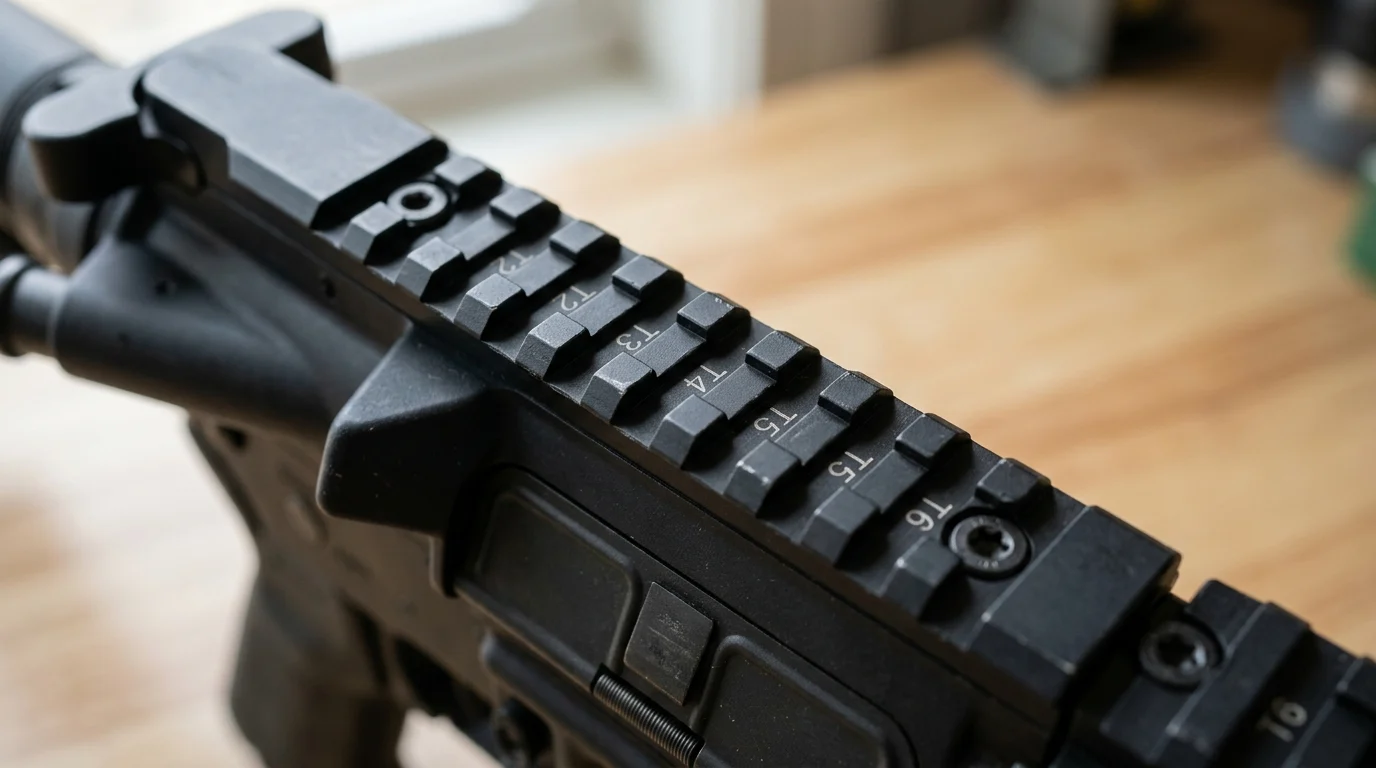
Dense timber punishes slow gear decisions. When a deer or hog appears in a narrow opening, the difference between a clean shot and a missed chance can be a few inches of eye relief or a fraction of a second finding the reticle. Picatinny rails give hunters a standardized mounting platform with repeatable slot spacing, making low-power optics easier to position for fast, natural alignment. But that flexibility comes with trade-offs: added weight, increased optic height, possible cheek-weld issues, and more snag points in brush. This guide breaks down how to choose and configure a close-range riflescope setup that stays quick, practical, and field-ready.
Why Picatinny Rails Change Thick-Woods Scope Choice
Hunters pushing through tangled briars and dense timber know that thick-woods hunting is a game of fractions of a second. A bruiser buck stepping into a narrow logging road doesn't wait for anyone to find their crosshairs. In these chaotic environments, standardizing on a Picatinny scope base fundamentally changes how a hunting rifle handles. Unlike traditional two-piece bases that lock optics into a fixed position, a continuous rail transforms the receiver into a highly adaptable mounting deck. Hunting in the thick woods is less about serene marksmanship and more about controlled chaos, making equipment adaptability paramount.
The true advantage lies in the MIL-STD-1913 specification. With cross-slots measuring exactly 0.206 inches wide and spaced 0.394 inches apart, hunters can slide their optics forward or backward in tiny increments. This micro-adjustment is a lifesaver when wearing heavy winter coats that alter a rifle's length of pull, ensuring the shooter's eye naturally aligns with the optic the moment the stock hits the shoulder. It essentially eliminates the frustrating trial-and-error associated with older proprietary dovetail systems and easily accommodates cantilever mounts or adjustments for rail length trade-offs depending on the action size.
However, a Picatinny rail is not always necessary. Rifles with integral scope bases, ultra-lightweight builds, or strict budget constraints might not benefit from the added hardware. Additionally, hunters must consider receiver compatibility; some action lengths may require specific rail designs or even minor gunsmithing for a proper, secure fit.
Close-Range Hunting Priorities
Close-range hunting means engaging targets between 15 and 75 yards, where a wide field of view and rapid target acquisition easily trump extreme magnification. In the timber, the top priority is keeping both eyes open to track moving game through narrow gaps in the foliage. The continuous rail allows the optic to be pushed further forward than traditional rings might permit, preventing the scope shadow that costs precious seconds when a wild boar suddenly breaks cover. A properly positioned optic acts almost like an unmagnified red dot sight, effortlessly funneling the hunter's vision directly onto the target.
Real-World Setup Challenges
Despite the immense benefits, this tactical-style setup introduces real-world challenges that hunters must actively mitigate. A standard aluminum rail typically adds between 2 to 5 ounces of weight and generally raises the optic's baseline by approximately 0.25 to 0.5 inches over the receiver, depending on the manufacturer. This extra height can severely compromise a tight cheek weld on traditional hunting stocks designed for low-mounted iron sights, sometimes necessitating an aftermarket cheek riser. Furthermore, the exposed slots of an extended rail can become a magnet for snagging twigs, leaves, and pine needles, requiring hunters to carefully manage their gear profile when busting through heavy brush.
Key Riflescope Specs for Thick Woods
Finding the perfect low-power rifle scope for a dense forest environment requires ignoring the modern trend of massive, high-magnification optics. In the timber, an oversized objective lens only serves to unbalance the rifle and snag on low-hanging branches. Instead, the focus must shift entirely to low-end magnification, generous eye relief, and optical clarity that can pierce through the gloom of a dense canopy at dawn.
Magnification, Objective Size, and Eye Relief
A true 1x or low 2x magnification setting is non-negotiable for thick woods, offering a massive field of view that often sweeps 90 to 115 feet at 100 yards. Objective lenses typically between 24mm and 32mm keep the rifle's profile sleek while delivering plenty of light to the shooter's eye. For instance, a typical 1-6x24mm optic set to its maximum 6x still provides an approximate 4mm exit pupil, which is generally adequate for daylight hunting under a heavy canopy. High-quality lens coatings are also vital to maximize light transmission during the crucial 30 minutes before sunrise. Additionally, heavy brush guns chambered in punishing calibers like .45-70 Government or .338 Winchester Magnum demand a forgiving eye relief of around 3.5 to 4.0 inches to prevent a painful scope bite during a rushed, off-balance shot.
Comparing 1-4x, 1-6x, and Similar Options
Choosing between low-power variable optics (LPVOs) comes down to balancing weight, zoom range, and target acquisition speed. The table below breaks down the most popular configurations for thick-woods setups on a continuous rail.
| Scope Configuration | Typical Weight | Field of View @ 100 yds (Low Mag) | Best Thick-Woods Application |
|---|---|---|---|
| 1-4x24mm | 14 – 16 oz | 95 – 115 ft | Fast-moving hogs, driven hunts |
| 1-6x24mm | 17 – 20 oz | 90 – 110 ft | Mixed timber and clearing edges |
| 2-7x32mm | 12 – 15 oz | 40 – 60 ft | Still-hunting, stationary ambush |
While the 1-4x24mm excels in rapid target acquisition, the 1-6x24mm offers a bit more versatility if a shot unexpectedly stretches across a clear-cut. The classic 2-7x32mm remains the lightweight champion for traditionalists, though it sacrifices the true two-eyed-open speed of a 1x baseline.
Mounting and Buying a Picatinny Rail Scope
Even the most expensive, crystal-clear optic will fail spectacularly if it rattles loose after brushing against a sturdy oak tree. The interface between the optic and the receiver is the most critical point of failure on any brush gun. Navigating the world of mounting hardware and accessories requires a meticulous approach to tolerances and torque specs, ensuring the crosshairs stay dead-on through brutal recoil and rough handling in the backwoods.
Ring Height, Torque, and Fit Checks
Because the base rail inherently adds elevation to the system, hunters usually need to step down their ring height to maintain a proper cheek weld. Instead of high rings, a sleek 24mm objective LPVO often pairs perfectly with low or medium rings measuring a compact 0.85 to 1.0 inches from the base to the center of the tube.
Key Takeaways
- Use a Picatinny rail when you need fine eye-relief adjustment for fast shots in dense cover.
- Prioritize low-power scopes with a wide field of view for typical thick-woods shots between 15 and 75 yards.
- Account for the added 2 to 5 ounces of rail weight before installing one on a lightweight hunting rifle.
- Check cheek weld after installation because a rail can raise the optic by roughly 0.25 to 0.5 inches.
- Confirm receiver compatibility before buying a rail, since action length and design can affect fit and security.
- Keep the rifle’s profile clean because exposed rail slots can catch twigs, leaves, and brush.
Frequently Asked Questions
Why is a Picatinny rail useful for thick-woods hunting?
A Picatinny rail gives hunters more fore-aft scope adjustment, helping them position a low-power optic for fast sight acquisition in dense cover where shots often happen inside 75 yards.
What Picatinny rail dimensions matter for scope mounting?
MIL-STD-1913 slots are 0.206 inches wide and spaced 0.394 inches apart, allowing repeatable ring placement and small adjustments to eye relief.
Does a Picatinny rail add noticeable weight?
Yes. A typical aluminum rail can add about 2 to 5 ounces, which may matter on lightweight hunting rifles carried all day through brush.
Can a Picatinny rail affect cheek weld?
Yes. Rails can raise the optic about 0.25 to 0.5 inches, which may require lower rings or an aftermarket cheek riser to maintain a consistent cheek weld.
What magnification works best in dense timber?
Low magnification is usually best. For 15- to 75-yard shots, a wide field of view and fast target acquisition are more important than high magnification.
Post time: Jul-10-2026