
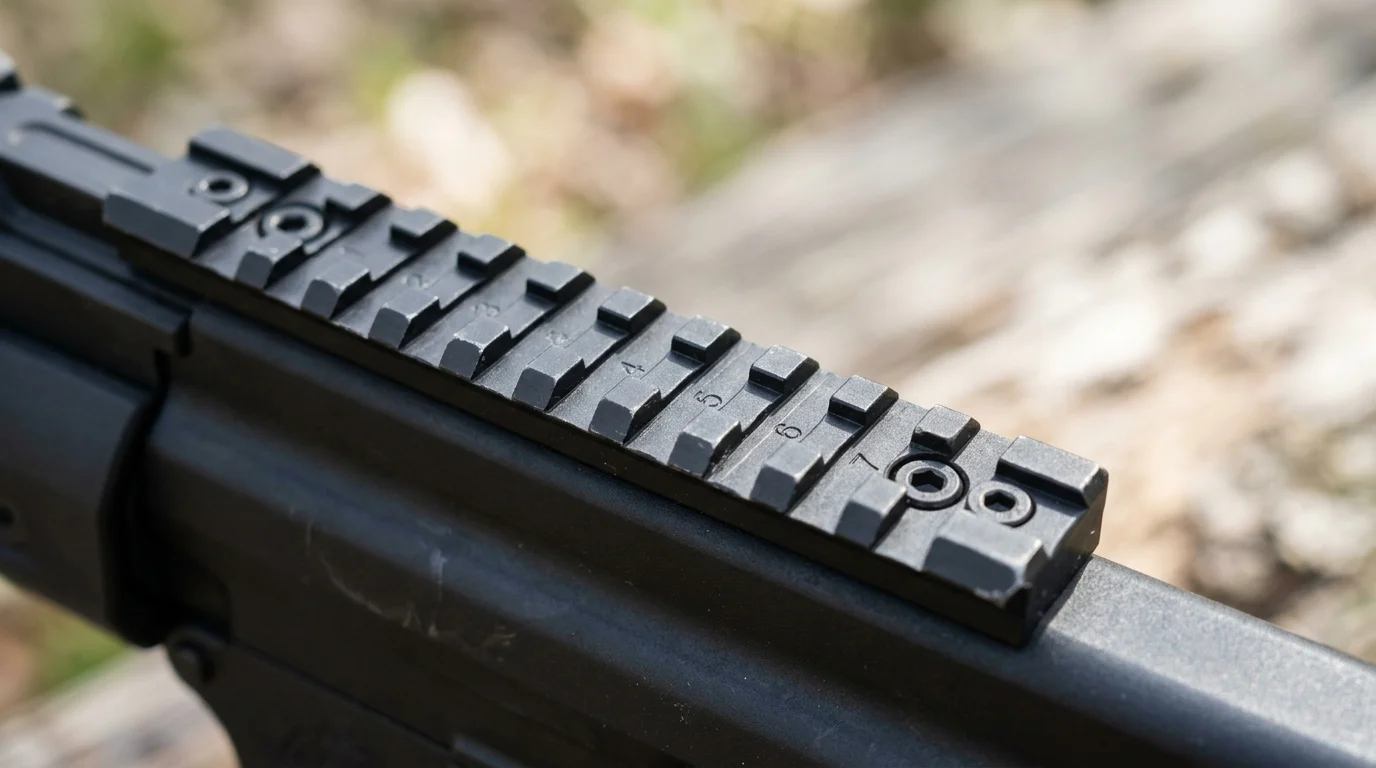
Picatinny Rail Basics and Fit Standards
The Picatinny rail, officially designated as MIL-STD-1913, significantly changed the firearms industry by providing a standardized mounting platform. Before its widespread adoption in the mid-1990s, shooters relied on proprietary mounting systems that limited modularity. Today, this standard allows optics, lasers, bipods, and other critical attachments to be swapped across various weapon platforms. Understanding the foundational specifications of a scope base is the first critical step in building a reliable, accurate setup.
Picatinny vs. Weaver and Dovetail Rails
While they look quite similar at a casual glance, Picatinny, Weaver, and Dovetail systems feature distinct dimensional differences that impact cross-compatibility. The Weaver system utilizes recoil slots that are typically 0.180 inches (4.57 mm) wide. More importantly, Weaver slot spacing is often inconsistent, varying based on the manufacturer’s specific design. Conversely, the Picatinny standard mandates a wider, uniform slot of 0.206 inches (5.23 mm) with strict spacing. Because of this dimensional difference, Weaver accessories will often drop into a Picatinny platform, but Picatinny-specific accessories feature thicker recoil lugs that will not fit into narrower Weaver slots. Dovetail rails, commonly found on rimfire rifles and airguns, use a completely different friction-grip design rather than transverse slots, typically measuring 11mm or 3/8-inch across the top flat.
Key Specifications for Proper Fit
The defining characteristic of a MIL-STD-1913 platform is its adherence to dimensional tolerances. Nominal specifications include a center-to-center groove spacing of 0.394 inches (10.01 mm) and a slot depth of 0.118 inches (3.00 mm), though real-world manufacturing tolerances vary by brand. The NATO STANAG 4694 standard, introduced in 2009, shifts the primary mounting contact points to the top flat surface to improve return-to-zero reliability. However, most commercial “Picatinny” rails still follow MIL-STD-1913, and because STANAG 4694 is largely backward-compatible, the distinction is rarely decisive for the average buyer. Verifying these measurements ensures recoil lugs engage properly, preventing optic shift under heavy recoil forces and maintaining zero in harsh conditions.
Materials, Profiles, and Mount Designs

Beyond dimensional standards, the structural integrity of your mounting platform depends heavily on the materials used and the specific profile of the base itself. Manufacturers offer a wide array of configurations designed to balance weight, rigidity, and cost, allowing shooters to tailor their equipment to specific operational environments and payload requirements.
Aluminum, Steel, Polymer, and Hybrid Options
The most common materials utilized in modern rail manufacturing are aluminum, steel, and reinforced polymers. Aluminum serves as the industry standard, specifically the 6061-T6 and 7075-T6 alloys. While 6061-T6 offers a tensile strength of roughly 45,000 psi, 7075-T6 nearly doubles that metric to approximately 83,000 psi, making it ideal for hard-use environments where weight savings are prioritized. Steel, typically 4140 chromoly, is heavier but provides excellent durability for .50 BMG or heavy magnum calibers. Polymer options are lightweight and cost-effective but possess lower shear strength, generally restricting them to .22 LR platforms or low-stress applications.
| Material | Tensile Strength (psi) | Weight Profile | Best Application |
|---|---|---|---|
| 6061-T6 Aluminum | ~45,000 | Light | General purpose, hunting |
| 7075-T6 Aluminum | ~83,000 | Light | Tactical, precision shooting |
| 4140 Steel | ~95,000+ | Heavy | Magnum calibers, heavy recoil |
| Polymer | Varies | Very Light | Rimfire, low-stress applications |
Note: Tensile strength alone does not guarantee field durability. Factors such as recoil-lug design, the quality of the anodizing or finish, and overall fatigue resistance play equally critical roles, especially for high-recoil calibers.
Profile, Slot Count, Height, and Attachment Style
The profile and slot count of the base determine your flexibility when positioning a mount or accessory for optimal eye relief. Long-action rifles require longer bases to bridge the receiver’s ejection port. For targets beyond 500 yards, shooters often select rails with built-in elevation (typically 20 or 30 MOA) to maximize the scope’s internal adjustment.
When choosing the mount itself, several styles exist. Traditional dual rings are lightweight and versatile. Single-piece monomounts offer superior rigidity and guarantee front-to-back alignment. Cantilever mounts push the optic forward, which is essential for proper eye relief on AR-style platforms. Finally, quick-detach (QD) mounts allow rapid removal and reattachment of optics without tools, though they can sometimes sacrifice a minor degree of return-to-zero precision compared to fixed mounts.
Choosing the Right Picatinny Rail Mount
Successfully pairing an optic or accessory with a firearm requires a systematic approach to compatibility. A mismatch in height clearances, tube diameters, torque application, or base-to-receiver fit can lead to poor accuracy, damaged optics, or inconsistent performance.
Step-by-Step Compatibility Check
The first step is verifying your rifle’s receiver drill-and-tap pattern, which dictates the screw spacing for the base (commonly #6-48 or #8-40 screws). Ensure the base sits flush against the receiver without rocking. Next, verify your optic’s main tube diameter (typically 1-inch, 30mm, or 34mm) to select the correct ring size.
When calculating ring height based on the objective lens and barrel contour, note that height definitions vary by manufacturer. The following figures are illustrative: a 50mm objective lens typically requires high rings (roughly 0.90 to 1.10 inches from the base top to the ring center), while a 32mm lens can use low rings (around 0.82 inches). Always leave a 2mm to 3mm gap between the objective bell and the barrel for lens covers and barrel whip.
During installation, degrease all screws and threaded holes, and apply a medium-strength threadlocker. Tighten base and ring screws in an alternating, crisscross sequence to ensure even pressure. Check that the scope tube makes full, even contact with the rings without pinching, and always confirm your zero at the range after mounting.
Budget, Application, and Performance Criteria
Budget and application dictate your hardware selection.
Key Takeaways
- Confirm that your firearm base and optic mount are compatible before buying, because the rail and the rings perform different jobs.
- Choose true MIL-STD-1913 dimensions when possible, including 0.206-inch slot width and 0.394-inch center-to-center groove spacing.
- Use 7075-T6 aluminum for hard-use setups where strength matters, since it offers about 83,000 psi tensile strength versus roughly 45,000 psi for 6061-T6.
- Do not assume Weaver and Picatinny parts are fully interchangeable, because Picatinny recoil lugs are often too wide for Weaver slots.
- Check recoil-lug engagement and rail tolerances carefully to reduce optic shift and maintain zero under recoil.
Frequently Asked Questions
What is a Picatinny rail?
A Picatinny rail is a standardized firearm mounting platform, officially MIL-STD-1913, used for optics, lasers, bipods, and other accessories. Its uniform slot dimensions help compatible mounts lock in securely and maintain zero.
Can Weaver accessories fit on a Picatinny rail?
Often, yes. Weaver accessories usually fit Picatinny rails because Weaver recoil lugs are narrower. However, Picatinny accessories may not fit Weaver rails because Picatinny recoil lugs are designed for wider 0.206-inch slots.
What is the difference between a rail and a mount?
The rail is the base attached to the firearm, while the mount or rings hold the optic or accessory to that base. Both must be compatible for a secure and repeatable setup.
Which Picatinny rail material is best?
Aluminum is the most common choice. 6061-T6 is affordable and strong, while 7075-T6 offers higher strength at similar weight. Steel is extremely durable but heavier, and polymer is best reserved for lighter-duty applications.
Why do Picatinny slot dimensions matter?
Correct slot width, spacing, and depth allow the mount’s recoil lug to engage properly. Poor fit can cause optic movement, loss of zero, or unreliable performance under recoil.
Post time: Jul-09-2026