
A rifle accessory mount may look simple, but small dimensional differences can decide whether an optic holds zero or drifts under recoil. The Picatinny rail became the dominant firearm mounting interface because it replaced inconsistent proprietary hardware with a repeatable, measurable standard. At the center of that system is MIL-STD-1913, the specification that defines the rail’s profile, recoil slots, and spacing so scopes, lights, lasers, and other accessories can mount securely across platforms. This overview explains the critical dimensions, why tolerances matter, how recoil lugs prevent movement, and where Picatinny differs from systems such as Weaver, NATO-pattern rails, M-LOK, and KeyMod.
Why the Picatinny Rail Remains the Common Standard
Step onto any modern firing line, and you will immediately spot the leading standard of firearm modularity: the Picatinny rail. Developed at the Picatinny Arsenal in New Jersey to solve the military’s need for a universal mounting interface, this standardized system became globally adopted. Before its introduction, attaching a scope or a tactical flashlight meant navigating a frustrating labyrinth of proprietary brackets and mismatched rings. Today, this distinctive, ladder-like mounting system is universally recognized, appearing on everything from precision rifles to civilian sporting shotguns and heavy machine guns.
Its success is no accident. By providing a rigid, repeatable, and universally understood geometry, the Picatinny design solved the long-standing problem of optical wander and component swapping under harsh conditions. To understand why it remains the bedrock of tactical hardware, one must look past its jagged exterior and dive into the meticulous engineering that makes it work.
What MIL-STD-1913 Defines
Officially adopted by the U.S. Department of Defense in 1995 as a standard for small-arms mounting rails, MIL-STD-1913 transformed the industry by standardizing how scope bases and rails should be shaped. The specification dictates a highly specific profile: a flat top flanked by angled sides with clamping surfaces machined at 45 degrees relative to the horizontal. More importantly, it enforces a strict pattern of transverse recoil slots.
According to the standard, every recoil groove has a nominal width of 0.206 inches (5.23 mm). Furthermore, the center-to-center spacing between these slots is specified at a nominal 0.394 inches (10.01 mm). While manufacturing tolerances apply, this cadence is strictly regulated. Whether a rail is three inches long or stretches across an entire upper receiver, that 0.394-inch spacing must remain highly consistent.
Why Tolerances and Recoil Slots Matter
Why do these dimensions matter? It all comes down to recoil management and optical precision. When a firearm discharges, the resulting kinetic energy sends massive shockwaves through the weapon. If an optic relies solely on clamping friction to stay in place, it will inevitably slide forward under recoil, destroying the shooter’s zero.
The 0.206-inch slots act as integrated recoil lugs. A properly machined mount features a crossbolt or recoil lug that sits snugly inside these grooves, physically blocking the optic from shifting. Because the tolerances are tightly controlled, shooters can remove an expensive thermal scope, pack it in a case, and reinstall it later in the same slots with minimal shift in zero. However, it is important to note that reliable accessory fit depends on the full cross-sectional profile, not just slot width and spacing.
Picatinny vs. Weaver, NATO, M-LOK, and KeyMod
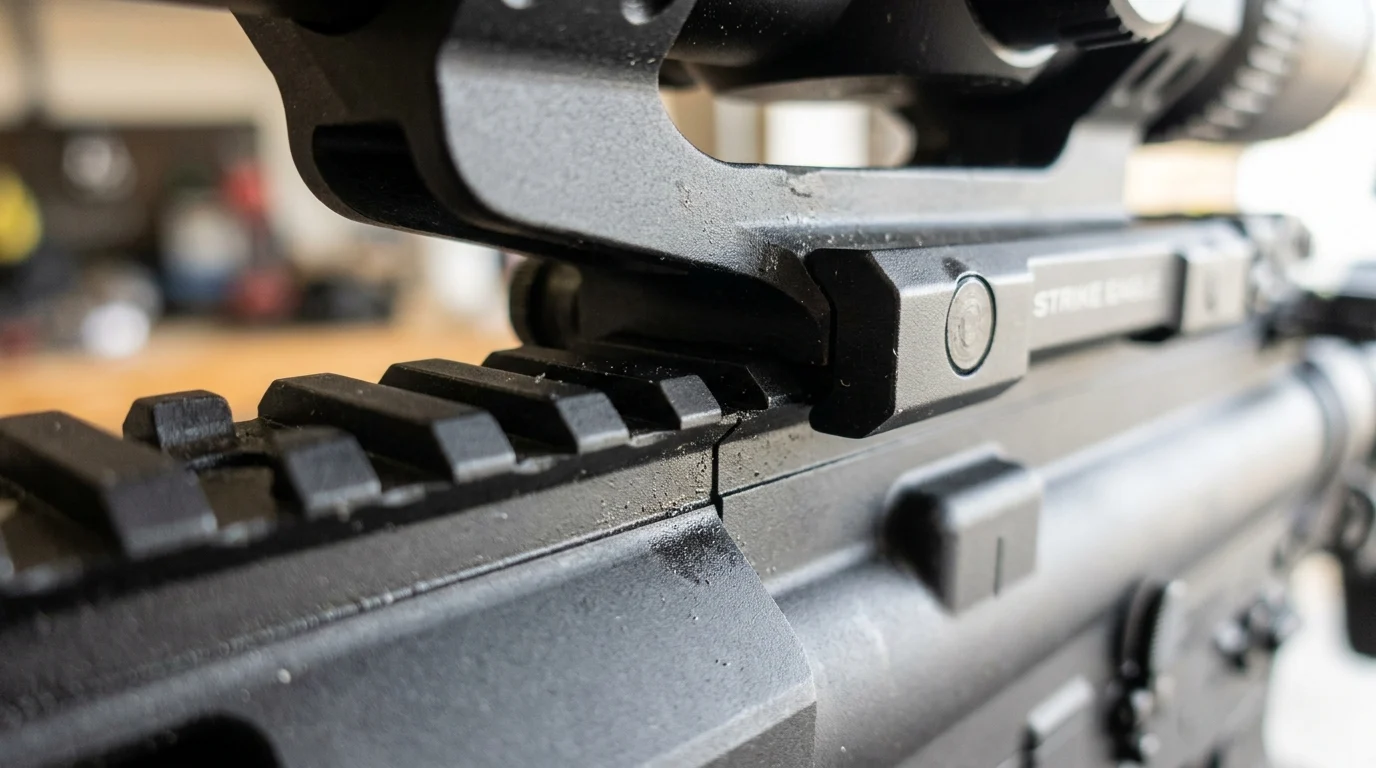
While the Picatinny design is iconic, it does not exist in a vacuum. The modern firearm market is crowded with mounting solutions. To truly appreciate MIL-STD-1913, one must see how it stacks up against its predecessors, its international upgrades, and newer negative-space contenders.
Key Specification Differences
The most frequent point of confusion lies between Picatinny and its older cousin, the Weaver system. To the untrained eye, they look nearly identical. However, Weaver slots measure only 0.180 inches wide, and historically, their spacing varied by manufacturer. While Weaver-to-Picatinny compatibility is practical, it is not guaranteed; a Weaver accessory will usually fit on a Picatinny system, but hybrid rings may fit loosely or fail to engage the recoil lugs properly. Conversely, a true Picatinny accessory—with its thicker recoil lug—will not fit into a narrow Weaver slot.
On the modern front, the NATO accessory rail (STANAG 4694) is an evolutionary update that refines the Picatinny profile. It grips both the top and bottom angles of the rail for enhanced repeatability. While designed to be backward compatible with legacy mounts, actual compatibility depends on the specific mount or accessory used. Meanwhile, systems like M-LOK and KeyMod ditch bulky external rails entirely, utilizing cutouts in the handguard to save weight and reduce the weapon’s outer diameter.
| Interface System | Slot/Lug Width | Spacing Standard | Primary Clamping Surface |
|---|---|---|---|
| Weaver | 0.180 in (nominal) | Variable | Bottom angles |
| Picatinny (MIL-STD-1913) | 0.206 in (nominal) | 0.394 in (nominal) | Bottom angles |
| NATO (STANAG 4694) | 0.206 in (nominal) | 0.394 in (nominal) | Top and bottom angles |
| M-LOK | N/A (Negative space) | Approx. 20.0 mm increments* | Inner handguard surface |
*Because M-LOK uses negative-space slots rather than protruding recoil lugs, direct dimensional comparisons to Picatinny are approximate.
Where Each Interface Fits Best
Understanding these differences dictates where each system fits best on a modern platform. M-LOK has become highly popular for handguards; in testing conducted by USSOCOM (Naval Surface Warfare Center Crane Division), M-LOK demonstrated superior pull-out strength and alignment retention, withstanding heavy loads while keeping the front end of the rifle smooth and lightweight. KeyMod, while innovative, has seen reduced adoption in recent years due to its slightly lower impact resistance in those same military trials.
Weaver is now mostly relegated to legacy sporting rifles and vintage hunting setups. However, when it comes to the receiver top-dead-center—the real estate dedicated to heavy and zero-critical optics—Picatinny and its NATO successor remain the dominant choices. The structural rigidity of the external rail is highly suited for these applications compared to negative-space alternatives.
How to Specify and Inspect a Picatinny Rail
Procuring or manufacturing a mounting interface requires more than just milling slots into a piece of aluminum. The market contains out-of-spec rails that look correct to the naked eye but fail to perform on the range. Knowing how to specify and inspect these components helps guarantee reliable performance.
Steps to Reduce Fitment Problems
The first step in preventing fitment issues is verifying the center-to-center slot spacing across the entire length of the component. Tolerance stacking is a major issue for one-piece mounts. If a manufacturer’s tooling is off by just 0.005 inches per slot, a mount designed to bridge ten slots will face a 0.
Key Takeaways
- MIL-STD-1913 standardized the Picatinny rail in 1995, giving firearm manufacturers a common mounting interface for optics and accessories.
- A true Picatinny rail uses 45-degree clamping surfaces and transverse recoil slots to create a secure mechanical lock.
- Picatinny recoil slots have a nominal width of 0.206 inches, or 5.23 mm, to accept crossbolts and recoil lugs.
- The nominal 0.394-inch, or 10.01 mm, slot spacing should remain consistent along the rail for reliable accessory placement.
- For repeatable optic mounting, reinstall the mount in the same rail slots and verify zero after removal or transport.
- Check full rail and mount compatibility, because slot dimensions alone do not guarantee a proper Picatinny fit.
Frequently Asked Questions
What is a Picatinny rail used for?
A Picatinny rail is a standardized mounting interface for optics, lights, lasers, grips, and other firearm accessories. Its consistent geometry lets compatible mounts lock into repeatable positions across different firearms.
What does MIL-STD-1913 define?
MIL-STD-1913 defines the rail profile, including 45-degree clamping surfaces and standardized transverse recoil slots. It was adopted by the U.S. Department of Defense in 1995 for small-arms mounting rails.
How wide are Picatinny recoil slots?
The nominal recoil slot width is 0.206 inches, or 5.23 mm. These slots accept crossbolts or recoil lugs that help stop mounted accessories from shifting under recoil.
What is the standard spacing between Picatinny slots?
Picatinny slot center-to-center spacing is nominally 0.394 inches, or 10.01 mm. Consistent spacing helps accessories return to the same position when removed and reinstalled.
Why do Picatinny tolerances matter for optics?
Tight tolerances help mounts fit securely and consistently. A properly fitted optic mount can resist recoil movement and may return closer to zero when reinstalled in the same slots.
Post time: Jul-09-2026