
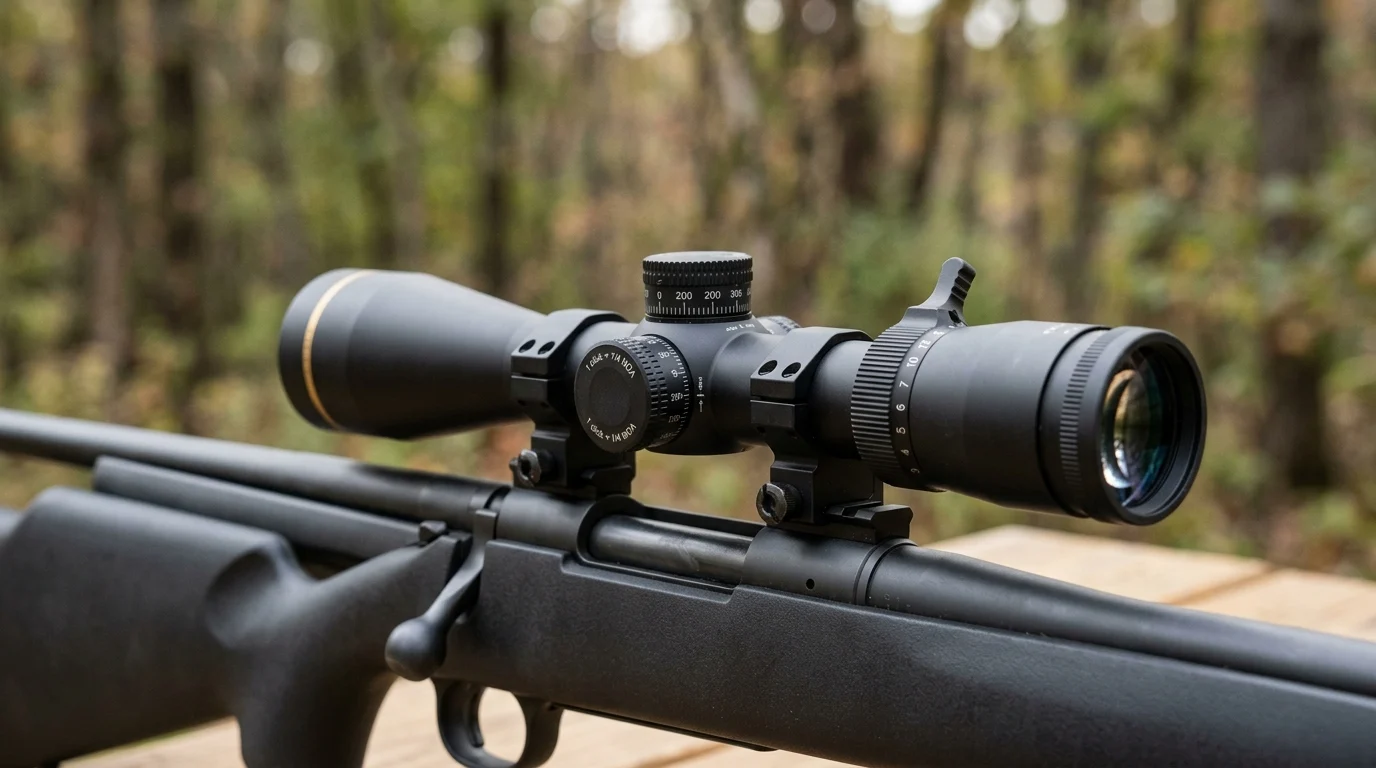
Every ounce matters when a rifle, pack, water, and weather gear have to climb thousands of vertical feet before the hunt even begins. For mountain hunters, the scope is one of the most effective places to cut weight without rebuilding the entire rifle. The challenge is choosing an optic that stays under the 18-ounce mark while still offering dependable recoil resistance, usable magnification, clear glass, and field-ready controls. This guide explains what makes a scope truly lightweight, where common design trade-offs appear, and how to compare magnification, tube size, turrets, objective diameter, and warranty support before committing to a backcountry setup.
Why Choose an Ultralight Mountain Hunting Scope
Mountain hunting is a demanding environment where gravity dictates gear choices. Trudging up a 10,000-foot alpine ridge with a heavy rifle drains energy long before the stalk begins, making weight reduction a priority for backcountry hunters. While carbon fiber stocks and fluted titanium barrels often receive the most attention, the optic is frequently the most practical place to shed excess bulk. Moving from a heavy precision rig to a streamlined setup significantly improves how a rifle carries on a sling during a multi-day expedition. However, this is a deliberate budget-versus-balance trade-off. Reputable ultralight scopes often command a price premium—typically ranging from $400 to over $1,000—and finding one with the internal durability to withstand magnum recoil, backed by a lifetime manufacturer warranty, is essential for long-term reliability.
What Defines a True Under-18 oz Scope
The 18-ounce (approximately 510 grams) mark serves as a practical threshold for defining an ultralight mountain optic. Hitting this weight class usually requires engineers to utilize a 1-inch main tube rather than the bulkier 30mm or 34mm tubes that dominate the long-range market. Manufacturers achieve these numbers by utilizing aerospace-grade aluminum alloys and stripping away external features like large locking turrets or illumination modules. Examples of this 1-inch class, based on manufacturer-stated specifications, include the Leupold VX-3HD 3.5-10x40mm (13.1 oz), the Swarovski Z3 3-10x42mm (12.7 oz), and the Maven RS.2 2-10x38mm (12.4 oz). The result is a highly streamlined hunting scope that provides reliability without disrupting the balance of a lightweight mountain rifle.
When to Trade Magnification for Weight Savings
Modern shooters are frequently tempted by 5-25x magnification ranges, but these larger optics routinely tip the scales at 30 to 40 ounces. For backcountry hunters, trading extreme magnification for weight savings is a strategic move. A classic 3-9x40mm or 2-10x42mm optic typically weighs between 12 and 15 ounces, offering adequate reach for a 400-yard shot across a canyon. Furthermore, these lighter scopes almost exclusively utilize Second Focal Plane (SFP) reticles. While focal-plane placement is not inherently limited by tube diameter, SFP optics generally require fewer complex internal lens elements than First Focal Plane (FFP) designs. This simpler internal mechanism directly contributes to the overall mass reduction. In the high country, carrying a lighter rifle ensures the shooter retains the stamina to hold steady when preparing to fire.
Key Specs to Compare Before Cutting Weight
Mounting the lightest possible optic onto a hunting rifle is simple, but ensuring it performs in the field requires a careful balancing act. Every ounce removed from an optic comes with a corresponding design compromise—such as reduced elevation travel or smaller objective lenses—that hunters must evaluate before heading into the wilderness. Understanding these core trade-offs ensures that weight savings do not compromise practical field performance.
Lens Size, Reticle Design, Turrets, and Eye Relief
To stay under the 18-ounce limit, manufacturers typically shrink the objective lens to between 33mm and 42mm. They also frequently replace exposed, dialing turrets with low-profile capped turrets. This design choice saves ounces and prevents accidental adjustments while navigating dense brush. Consequently, these scopes offer limited total elevation travel and rarely include zero-stop mechanisms. Additionally, many sub-18-ounce scopes rely on fixed parallax (commonly set at 100 or 150 yards), which can introduce aiming errors at distances significantly closer or further than the factory setting.
Eye relief is also critical in this weight class; a lightweight magnum rifle produces sharp recoil, requiring 3.5 to 4 inches of eye relief to prevent scope bite. Securing these compact optics with a minimalist scope mount or a skeletonized base rail ensures the system remains balanced.
| Feature | Ultralight Scope (<18 oz) | Heavy Tactical Scope (>30 oz) | Weight Impact |
|---|---|---|---|
| Objective Lens | 33mm – 42mm | 50mm – 56mm | Reduces overall mass |
| Tube Diameter | 1-inch (25.4mm) | 30mm or 34mm | Lighter tube assembly |
| Turrets | Capped, low-profile | Exposed, locking | Eliminates heavy mechanics |
| Reticle Focus | Second Focal Plane | First Focal Plane | Fewer internal lens elements required |
Low-Light Performance in Real Hunting Conditions
The primary concern with smaller objective lenses is reduced light transmission during dawn and dusk. However, the optical math often remains practical for standard hunting scenarios. A 36mm objective lens set at 6x magnification produces a 6mm exit pupil. While a young adult’s eye can dilate to about 7mm in extreme low light, maximum pupil dilation decreases significantly with age, often capping around 5mm for older hunters. Therefore, a 6mm exit pupil still delivers usable light for legal shooting hours. A smaller 36mm objective objectively gathers less light than a 50mm or 56mm counterpart; the advantage is portability, not equivalent low-light performance. Nevertheless, when paired with fully multi-coated glass that maximizes light transmission, hunters can effectively identify targets in shadowed environments without a massive objective.
How to Choose and Validate the Right Scope
After selecting a featherweight optic that meets the necessary specifications, the final step is proving it can survive the physical demands of the backcountry. An ultralight setup is compromised if a minor impact knocks the reticle off zero. Validating the scope’s mechanical integrity is a necessary precaution for a successful hunt.
Field Tests for Tracking and Durability
Rigorous field testing is mandatory before taking any lightweight optic on an expedition. The most critical evaluation is the standard “box test” to verify tracking linearity and return-to-zero reliability. Shooters should fire a baseline group, then adjust the turrets 10 MOA up, 10 MOA right, 10 MOA down, and 10 MOA left, firing a multi-shot group at each adjustment point to confirm accurate tracking before the final group returns precisely to the original zero. Pairing the optic with a sturdy bipod system helps confirm this mechanical consistency from a stable prone position.
Hunters must also diagnose potential fixed-parallax aiming errors.
Key Takeaways
- Use 18 ounces, or roughly 510 grams, as the practical cutoff when comparing ultralight mountain hunting scopes.
- Prioritize proven durability and a lifetime warranty over shaving the last ounce, especially for magnum rifles.
- Choose a 3-9x40mm or 2-10x42mm scope if you want enough reach for typical mountain shots while staying near 12 to 15 ounces.
- Expect most true ultralight scopes to use 1-inch tubes, 33mm to 42mm objectives, capped turrets, and simplified feature sets.
- Avoid heavy 5-25x optics for steep backcountry hunts unless long-range dialing performance is more important than carrying comfort.
Frequently Asked Questions
What weight qualifies as an ultralight mountain hunting scope?
A practical benchmark is under 18 ounces, or about 510 grams. Scopes in this class usually use 1-inch tubes, compact objectives, and simplified controls to reduce weight without making the rifle feel unbalanced.
Is a 3-9x or 2-10x scope enough for mountain hunting?
Yes. A 3-9x40mm or 2-10x42mm scope is typically sufficient for practical mountain hunting distances, including shots around 400 yards, while keeping weight far below large 5-25x long-range optics.
Why are most sub-18 oz hunting scopes Second Focal Plane?
Second Focal Plane scopes often use simpler internal designs than First Focal Plane models, which helps reduce weight. For many hunters, SFP reticles are also familiar and practical at normal hunting magnifications.
What features are commonly sacrificed to save scope weight?
Ultralight scopes often use smaller objective lenses, capped turrets, 1-inch tubes, and fewer extras such as illumination or large locking turrets. These choices reduce mass but may limit low-light performance, elevation travel, or dialing convenience.
Are lightweight scopes durable enough for magnum recoil?
Some are, but durability matters more than weight alone. Choose a reputable model with proven recoil resistance and a strong warranty, especially if pairing the optic with a hard-kicking mountain rifle.
Post time: Jul-31-2026